Illustrated checklist for the species of Amanitaceae of the Great Smoky Mountains National Park
R. E. Tulloss
P.O. Box 57, Roosevelt, NJ 08555-0057
 The background image for this page is titled "Ed Lickey Gets the
Whole Thing," It stars Ed & Amanita daucipes. The
photos utilzed were taken by Dr. D. J. Lodge. Manipulation with
Photoshop by RET.
The background image for this page is titled "Ed Lickey Gets the
Whole Thing," It stars Ed & Amanita daucipes. The
photos utilzed were taken by Dr. D. J. Lodge. Manipulation with
Photoshop by RET.
This page provides a view of
Amanita
and
Limacella species and their distribution in the Great Smoky
Mountains National Park (GSMNP) based on monographic literature and from unpublished data of R. E. Tulloss. If this document is browsed while on-line, the entries marked "[
page ]" in the text will provide access to brief descriptions of the relevant taxa and, in some cases, access to the fullest available taxonomic descriptions.
For the purposes of this study, we have
confirmed 67 taxa in
Amanita and
1 in
Limacella known
to occur in GSMNP based on monographic literature, Hesler's Notebooks and
photographs, the University of Tennesee herbarium (TENN) collections, and
Tulloss' unpublished data including data from the 1999-2006 collecting
years of the GSMNP fungal All-Taxa Biodiversity Inventory (ATBI)
project. The names of confirmed taxa listed for the Park prior to
the Fungal TWIG work in the ATBI appear in the list in
black bold
italic type.
Names new to the Park since the beginning of the Fungal TWIG work in
the ATBI, appear in
red bold
italic type. At present,
37 names on the list are in this
category. These names
are included in the count of
confirmed taxa.
Names that are based on
probably correct field IDs appear in
green bold italic type. At
present
3 names on the list
are in this latter category; these are
not included in the count
of "confirmed" taxa.
Of the taxa that have been confirmed for the Park, it is worth noticing
that
27 (
over forty percent
of the confirmed taxa) have not been described or are known under a
misapplied or provisional name and will require validation or description
as new. Such taxa are marked in this document with a bold face,
white asterisk on a green background
(
*). In addition, two of the green bold
italic taxa bear the white asterisk.
At least
121 taxa of the
Amanitaceae are known to be present or are possibly or probably
present (including taxa known from surrounding areas in, or close
to, the Appalachian Mountains in Kentucky, North and South Carolina,
Tennessee, and West Virginia); and surely there is more than one taxon
belonging to
Limacella in the park. Based on my
35
+ years of collecting in the northeastern U.S., several
trips to eastern Texas and the Gulf Coast, 5 trips for collecting in
central Mexico (which appears to share several taxa with the Smokies),
and one collecting trip in the Cordillera Talamanca (Costa Rica) as well
as review of large numbers of collections by others ranging southward to
the
Quercus forests of Andean Colombia, I believe it is reasonable
to assume that future lists will include as many as 200 confirmed taxa of
the
Amanitaceae in the Park.
RET's 2004 and 2006 collecting in the Park were largely supported by the
Biology Department of the University of Tennessee, Knoxville, based on a
National Science Foundation grant. I express my gratitude to Drs.
Karen Hughes and Ronald H. Petersen for their support and for their
inclusion of me in the process.
Molecular data utilized in preparing the versions of this document since
August, 2015 was predominantly provided by the labs of Drs. Karen Hughes
see above) and Linas V. Kudzma (Annandale, New Jersey).
Thanks to all the ATBI and mycoblitz participants. May you always have good hunting!
[ Introduction ]
[ Interpreting this checklist ]
[ Amanita section Amanita ]
[ Amanita section Caesareae ]
[ Amanita section Vaginatae ]
[ Amanita section Amidella ]
[ Amanita section Lepidella ]
[ Amanita section Phalloideae ]
[ Amanita section Validae ]
[ Limacella ]
[ Literature Cited ]
Interpreting this checklist
Herbarium codes not in
Index Herbariorum:
-
DTJ = priv. herb. of D. T. Jenkins
-
RET = priv. herb. of R. E. Tulloss
Other symbols and codes:
-
BAS69 = cited in the 1969 thesis of C. Bas [authority accepted unless otherwise stated]
-
DJL = initial letters of a D. J. Lodge collection number
-
FU- = prefix to 1999 ATBI collection numbers
-
H- = prefix to TENN numbers that are Hesler collections
-
HN = Hesler's Notebooks
-
HPL = Hesler-Petersen List [GSMNP ATBI fungal TWIG base-line]
-
JE77 = cited in 1977 thesis of D. T. Jenkins [authority accepted unless otherwise stated]
-
LLN = initial letters of a L. L. Norvell collection number
-
TFB = Tennessee Field Books of R. H. Petersen
-
u.d. = unpublished data of Tulloss
Vouchers: In the following lists of species, each element known from the park is followed by a list of the sites in GSMNP from which that element is
known. Lists of herbaria in which vouchers from a given site have been reviewed or are known to exist are provided in square brackets. Each herbarium abbreviation is followed by one or more references in parentheses. (See the "Literature Cited" section at end of this list.) When collecting numbers are known, they are provided after the square brackets. When definitive determinations of such collections are available, an ATBI collection number or other collection number will be added to the information for the relevant name in bold face type. For many of Hesler's collections there are diagnosable photographs in TENN. Question marks before a locality name indicate uncertainty of diagnosis of the collection, not of the locality.
Spore data has been added for many species. If the amount of data is very limited for a given species, it is derived from the literature.
The format for RET's spore data is explained in a teaching topic on the upper left of this page.
[ Introduction ]
[ Interpreting this checklist ]
[ Amanita section Amanita ]
[ Amanita section Caesareae ]
[ Amanita section Vaginatae ]
[ Amanita section Amidella ]
[ Amanita section Lepidella ]
[ Amanita section Phalloideae ]
[ Amanita section Validae ]
[ Limacella ]
[ Literature Cited ]
[
top]
[
skip section]
Amanita section Amanita
[13 known from park of 17
+ probable]
-
Amanita agglutinata (Berk. & E. A.
Curtis in Berk.) Lloyd
[ image ]
[ page ]
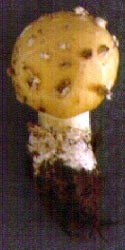
Collected within the last few decades in Kentucky (photograph). Cap
probably is significantly paler when expanded (original description says
it is white a term used for a wide range of pallid coloration in the
19th C. literature. TENN records not revised by Jenkins or a later
author are
probably assignable to one of the taxa of section Amidella.
Spores per type study of JE77: 9 - 12.5 × 5.5 - 8 µm, (Q = 1.40 - 1.90;
Q' = 1.62). Spores from single Kentucky specimen [RET]:
[20/1/1] 8.5 - 11 (-14.8) x (5.5-) 6.0 - 7.2 (-7.5) µm, (L =
10.5 µm; L’ = 10.5 µm; W = 6.6 µm; W’ = 6.6 µm;
Q = (1.40-) 1.42 - 1.77 (-2.28); Q = 1.59;
Q’ = 1.59).
-
Amanita albocreata G. F. Atk. [ image ]
[ page ]
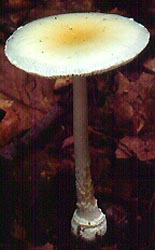
Known in association with Tsuga and Abies as far north as
central Québec and the Island of Newfoundland. The central
Appalachians are the southern limit of the known range. Spores:
[121/6/6] (7.3-) 7.7 - 9.5 (-11.6) × 6.6 - 8.4 (-9.4) µm,
(L = 8.1 - 9.0 µm; L’ = 8.7 µm; W = 7.1 - 8.1 µm;
W’ = 7.6 µm; Q = (1.0-) 1.04 - 1.23 (-1.32);
Q = 1.10 - 1.16; Q’ = 1.14).
Indian Creek [TENN RET(u.d.)] H-24419
-
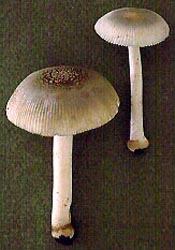
Amanita farinosa
Schwein. [ image ]
[ page ]
Known in association with Quercus from southern Québec to the
Cordillera Talamanca of Costa Rica. Spores: [160/8/8] (6.0-)
6.5 - 8.8 (-10.5) × (5.2-) 5.5 - 7.0 (-9.0) µm, (L = (6.8-)
7.1 - 8.0 µm; L’ = 7.4 µm; W = 5.8 - 6.4 (-6.5) µm;
W’ = 6.1 µm; Q = (1.03-) 1.08 - 1.38 (-1.47); Q =
1.15 - 1.27 (-1.31); Q’ = 1.22).
Alum Cave trailhead [RET (u.d.)] RET 7-13-04-C
Baskin's Ridge trailhead [RET (u.d.)] RET 7-12-04-AC
Cades Cove [DTJ, TENN (JE77)] H-24526
Cades Cove, Picnic Area [RET (u.d.), TENN] H-??
Cataloochee Valley [RET (u.d.)] FU-0334
Grotto Falls Tr. [RET (u.d.)] RET 7-12-04-P
Madrone Bald tr. head [RET (u.d.)] RET 9-30-06-G
-
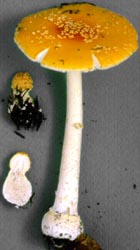
Amanita frostiana (Peck)
Sacc. [ image ]
[ page ]
Central Appalachians are the known southern limit of its range.
The northern limit is in Québec. Spores: [199/10/6] (7.5-)
8.5 - 10.5 (-12.5) × (7.5-) 7.8 - 9.8 (-11.3) µm, (L = (8.5-)
9.0 - 9.6 µm; L’ = 9.2 µm; W = (8.1-) 8.5 - 9.2 µm;
W’ = 8.7 µm; Q = 1.0 - 1.12 (-1.17);
Q = (1.04-) 1.05 - 1.08; Q’ = 1.06).
Cades Cove [DTJ, TENN (JE77)] H-21667
-
Amanita gemmata* sensu Dav. T. Jenkins
The epithet "gemmata" applies to a Eurasian taxon that is
apparently not present in N. America. Amanita russuloides
(Peck) Sacc. & other spp. fall within Jenkins' rather broad concept
of A. gemmata. The latter name has been applied to other
taxa in the Americas including A. xylinivolva Tulloss, Overbo
& Halling and A. aprica J. Lindgr. & Tulloss, and several
still undescribed species. At present, the appearance of this name
in checklists is not useful for such things as biogeographical
comparisons.
Cades Cove [TENN, (JE77)] H-26109, H-28212, H-29719
?Cataloochee Valley [RET (u.d.)]
Parsons Branch [DTJ (JE77)]
Roaring Fork [DTJ (JE77)]
-
Amanita monticulosa (Berk. & E. A. Curtis) Sacc. [ page ]
The cap color of this species is unknown. No illustration of the
species is known. Jenkins stated that it was distinguished by the
pointed warts on the cap and a felted patch of volva at the top of the
basal bulb as well as by the size and shape of the spores.
Originally described from South
Carolina. Spores per type study of JE77: 9.8 - 11.2 × 7.0 - 8.0
(-9.0) µm, (Q = 1.19 - 1.50; Q' = 1.35).
-
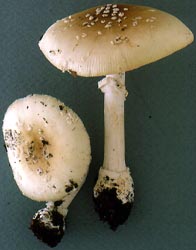
Amanita multisquamosa Peck [ image ]
[ page ]
[=A. cothurnata G. F. Atk.]
[=A. pantherina var. multisquamosa (Peck) Dav. T. Jenkins]
Range data for this species is not well established. It certainly
exists as far north as southern Canada. Spores:
[72/4/4] (6.6-) 7.0 - 11.2 (-15.0) × (5.2-) 5.6 - 8.4 (-8.7) µm,
(L = 7.8 - 9.8 µm; L’ = 8.8 µm; W = 6.3 - 7.1 µm;
W’ = 6.7 µm; Q = (1.05-) 1.12 - 1.50 (-1.58); Q =
1.22 - 1.39; Q’ = 1.31).
Cades Cove [DTJ, TENN (JE77)] H-18566, H-25623
rd. btwn. Cherokee Orchard & Grotto Falls trailhead [RET (u.d.)] RET 7-12-04-N
Elkmont [TENN (JE77)] H-10405, H-24600
Noland Crk. Tr. [TENN/RET (u.d.)] RET 7-11-04-A
Roaring Fork [DTJ (JE77)]
-
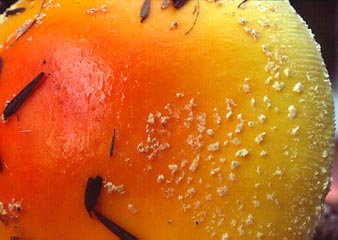
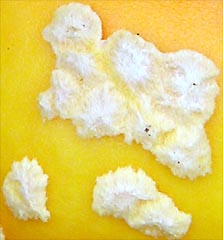
Amanita muscaria var. guessowii Veselý [image]
[page]
[=Amanita muscaria var. formosa sensu Dav. T. Jenkins]
Range for this color variant of the provisionally
named Amanita amerimuscaria extends
at least to central Quebec and the Island of Newfoundland.
The author is uncertain of its southern limit. One of the
causes of uncertainty is that the purple pigment in "red fly
agarics" is rather quickly destroyed in sunlight.
Hence, "yellow" or "orange" taxa are reported
from regions in which var. guessowii does not exist.
Spores: [120/6/6] (7.0-) 8.7 - 12.2 (-14.8) × (5.9-) 6.5 - 8.2 (-9.5)
µm, (L = 9.2 - 11.4 µm; L’ = 10.5 µm; W = 7.1 - 7.8
µm; W’ = 7.5 µm; Q = (1.09-) 1.27 - 1.56 (-1.70); Q =
1.30 - 1.49; Q’ = 1.42).
Cataloochee Valley [RET (u.d.)] FU-0002, FU-0110, FU-0338
-
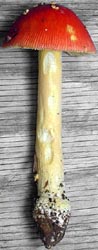
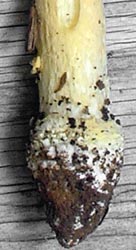
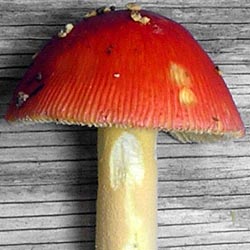
Amanita parcivolvata (Peck) E.- J. Gilbert [ image ] [page]
This species is exannulate from the outset. From the top, this
species (especially when lacking volval warts) can suggest
A. jacksonii of Amanita sect.
Caesareae. The range of this
species extends from New Jersey to the Gulf Coast. Spores:
[87/5/4] (8.4-) 9.1 - 11.5 (-12.6) × (5.6-) 6.3 - 7.9 (-8.0) µm,
(L = 9.9 - 10.9 µm; L’ = 10.4 µm; W = 6.7 - 7.3 µm;
W’ = 7.0 µm; Q = (1.26-) 1.31 - 1.64 (-1.67); Q = 1.38 -
1.55; Q’ = 1.48).
Cades Cove [TENN (JE77)] H-23050
-
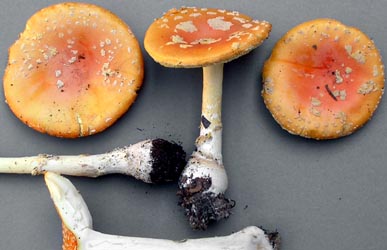
persicina (Dav. T. Jenkins) Tulloss & Geml [ image ]
[ page]
This taxon is distinguishable by the limited about of volval remnants on
the stipe base, the median annulus, the stipe pigmentation (yellow above,
white below), and somewhat narrower spores than in var.
guessowii. It
is generally considered a taxon of the SE USA, but has recently been
found as far north as Long Island, New York, and Sussex Co., New
Jersey. A recent collection was displayed at the 2006 NAMA Regional
Foray at Wildacres, North Carolina. Spores: [202/10/7] (8.0-)
9.2 - 12.0 (-15.8) × (5.5-) 6.4 - 8.3 (-11.1) µm, (L = 9.8 - 11.1
(-11.4) µm; L’ = 10.6 µm; W = 6.8 - 7.6 (-7.8) µm;
W’ = 7.3 µm; Q = (1.19-) 1.33 - 1.61 (-1.75); Q = 1.43 -
1.50 (-1.52); Q’ = 1.46).
Cades Cove [DTJ (JE77)] !!TYPE LOCALITY!!
-
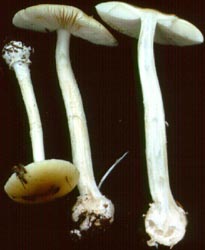
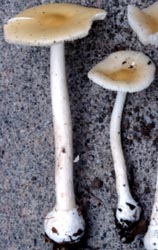
Amanita praecox Lamoureux nom. prov.* [ image ] [ page ]
[=Amanita sp-32 Tulloss cryptonom. temp.]
This is a new species, also known from habitat similar to that in which
it is found in GSMNP (mixed
forest including Tsuga) as far north as the Province of
Québec.
Prior to the publication of Lamoureux's provisional name, RET called the
species "Amanita sp. 32."
On the Island of Newfoundland, the species occurs with conifers other
than Tsuga. The name "A. gemmata"
has undoubtedly been applied to this taxon. At present, the
central Appalachians is the known southern limit of this taxon's
range. Spores: [286/14/13] (6.3-) 7.3 - 9.8 (-12.6) × (5.6-)
7.0 - 9.1 (-11.9) µm,
(L = (7.6-) 7.9 - 9.3 µm; L’ = 8.6 µm; W =
(7.1-) 7.3 - 8.4 µm; W’ = 7.9 µm;
Q = 1.0 - 1.17 (-1.42); Q = 1.05 - 1.10 (-1.11); Q’ =
1.08).
Cades Cove, Anthony Creek Tr. [TENN (u.d.)] ?? (=TFB 13224)
Cades Cove, ca. Primitive Baptist Church [TENN (u.d.)] 60935 (=TFB 13108)
Cataloochee Valley [RET (u.d.)] FU-0109, FU-0237
Greenbrier, Whaley Cemetery (manway above) [TENN (u.d.)] ?? (=TFB 13219)
Huskey Gap Tr. [TENN (u.d.)] 60564 (=TFB 12490)
Sugarlands Visitor Center area [RET (u.d.)] FU-0131
-
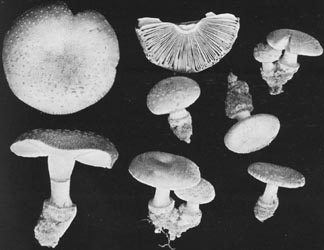
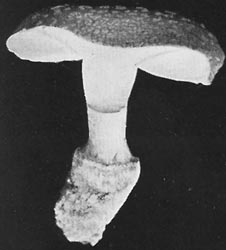
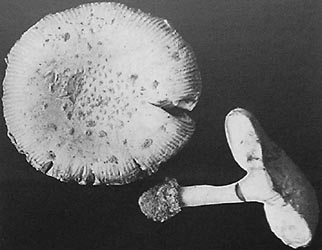
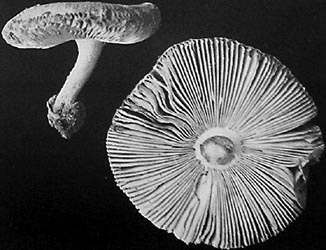
Amanita pubescens sensu Coker [ image] [page ]
It has not been established that Coker's taxon is indeed the species
described by Schweinitz. However, it does appears to be a
distinctive taxon ranging southward and westward to Texas and
Oklahoma. Coker may have mixed some collections of his
pubescens with exannulate collections of A. recutita sensu
Coker (lower pair of images; see
below). Notice the somewhat radicating bulb (to which Coker
called attention) in the present taxon. Photographs are by W. C.
Coker from (Coker, 1917).
[40/2/1] (9.3-) 9.5 - 11.5 (- 12.0) × (6.5-) 6.8 - 8.0 (-9.3) µm,
(L = 10.0 - 10.7 µm; L' = 10.4 µm; W = 7.4 -
7.6 µm; W' = 7.5 µm; Q = (1.28-) 1.31 - 1.50 (-1.53);
Q = 1.37 - 1.41; Q' = 1.39). Note spore similarity
to A. recutita sensu Coker. That species has a hollow stipe
and a partial veil and belongs to Amanita sect.
Caesareae.
-
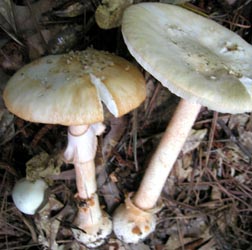
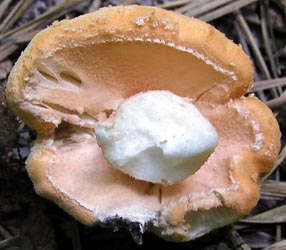
Amanita roseitincta (Murrill) Murrill [ image ]
[ page ]
[=A. komarekensis Dav. T. Jenkins & Vinopal]
Unique in North American amanitas in having an apparently layered
volva comprising a layer of pyramidal grayish warts above a layer of
pinkish or orangish pulverulence. The underside of the partial
veil is pink or orange-white before fading. The range of this
species extends from New Jersey to central Mexico. Spores:
[336/10/7] (7.6-) 8.5 - 11.8 (-14.4) × (5.1-) 6.0 - 8.2 (-10.0) µm,
(L = 9.2 - 10.9 µm; L' = 9.8 µm; W = 6.3 - 7.6 µm;
W' = 7.0 µm; Q = (1.09-) 1.20 - 1.69 (-2.08); Q = 1.33 -
1.50; Q' = 1.42).
-
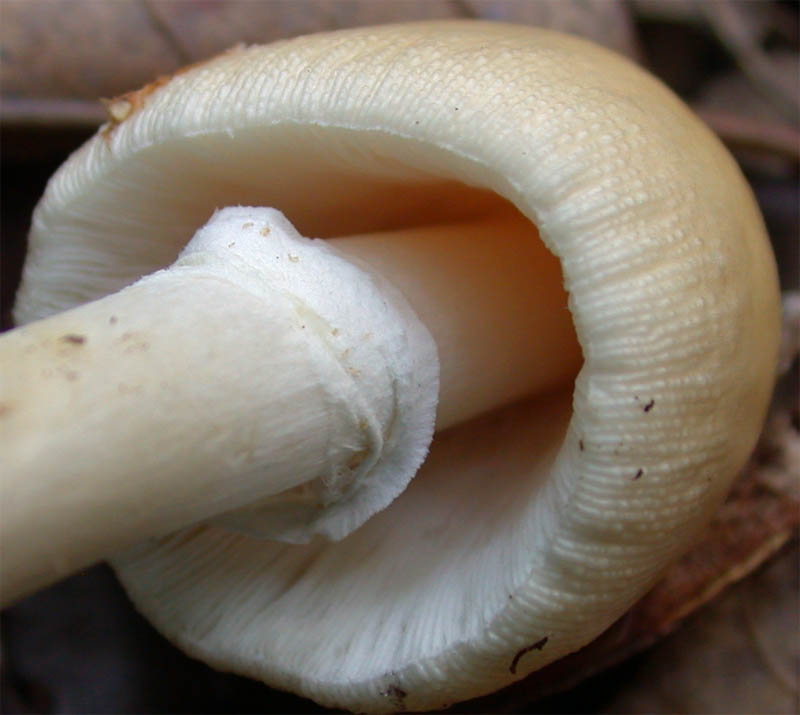
Amanita subvelatipes Tulloss, Haelewaters, Geml, & K. W. Hughes
[ image ] [page ]
u.d.
Spores:[35/2/2] (7.8-) 8.5 - 10.5 (-11.0) × (4.0-) 6.4 - 8.4 (-8.6) μm, (L = 9.0 - 9.4 μm; L' = 9.2 μm; W = 6.6 - 7.8 μm; W' = 7.2 μm; Q = (1.07-) 1.13 - 1.45 (-1.62); Q = 1.22 - 1.38; Q' = 1.29)
-
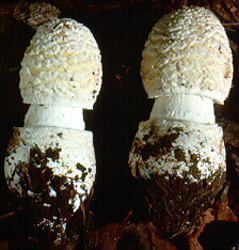
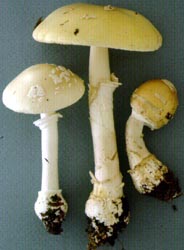
Amanita velatipes G. F. Atk. [ image ]
[ page ]
[= Amanita pantherina var. velatipes (G. F. Atk.) Dav. T. Jenkins]
Considered a species of the NE USA and SE Canada. Reliable,
detailed range data, not known to the author.
Spores: [121/6/6] (6.0-) 8.0 - 10.5 (-11.5) × (4.5-) 5.5 - 7.2 (-7.8)
μm, (L = (6.9-) 8.9 - 10.1 μm; L' = 9.2 μm; W
= (5.1-) 5.9 - 6.8 μm; W' = 6.4 μm; Q = (1.13-) 1.28 - 1.62
(-1.73); Q = 1.35 - 1.51; Q' = 1.44).
Cades Cove [TENN (JE77)] H-21464, H-22582
?Cataloochee Valley [RET (u.d.)] FU-0553
Cherokee Orchard [TENN (JE77)] H-12711
Keener House [TENN or MICH (HN)] A. H. Sm. 9653
Mt. LeConte [TENN (JE77)] H-26285
Roaring Fork [DTJ (JE77)]
-
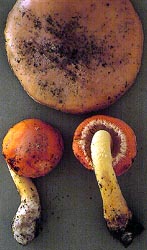
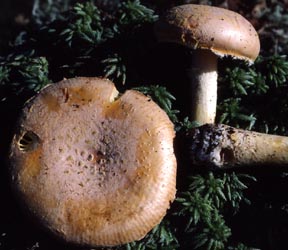
Amanita wellsii (Murrill) Murrill [ image ]
[ page ]
Known from north of the tree line in eastern Canada (apparently with
Alnus) and in a variety of heaths
with dwarf Betula, dwarf Salix, Empetrum, and/or
Vaccinium; elsewhere, associates may include
Vaccinium (in cultivated blueberry fields), Betula,
Populus, and (?)conifers. The central
Appalachians is the known southern limit of this taxon's
range. Note the degree of fading due to exposure to sunlight
in the pilei depicted above. Spores: [395/19/14] (8.7-) 10.5 -
13.8 (-18.0) × (4.9-) 5.6 - 8.4 (-10.8) µm,
(L = (10.6-) 11.5 - 13.0 (-13.2) µm; L’ = 12.0 µm;
W = (5.3-) 6.7 - 7.6 (-8.6) µm; W’ = 7.1 µm;
Q = (1.39-) 1.50 - 1.94 (-2.62); Q = (1.52-) 1.62 - 1.76 (-1.92);
Q’ = 1.69).
Newfound Gap [TENN (JE77)] H-21487
Smokemont [TENN (JE77)] H-20522
-
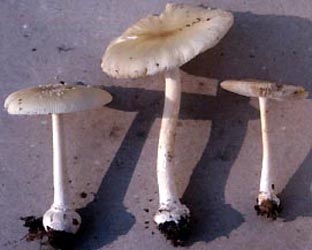
Amanita sp-34 Tulloss cryptonom. temp.* [ image] [ page ]
A very small species associated with oaks and conifers. Spores:
[60/3/3] (8.2-) 8.5 - 10.4 (-10.8) × (6.3-) 6.5 - 7.5 (-8.6) µm,
(L = 9.0 - 9.7 µm; L’ = 9.4 µm; W = 6.9 - 7.0 µm;
W’ = 7.0 µm; Q = (1.19-) 1.22 - 1.48 (-1.55); Q = 1.29 -
1.40; Q’ = 1.36).
rd. btwn. Cherokee Orchard & Grotto Falls [RET (u.d.)] RET 7-12-04-O
-
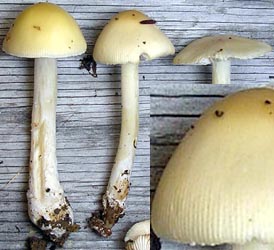
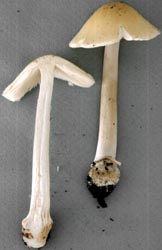
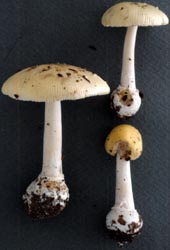
Amanita sp-S01 Tulloss cryptonom. temp.* [ image ] [ page ]
Originally collected in western South Carolina, this taxon is usually
exannulate and may appear to belong in Amanita sect.
Vaginatae before its stem's bulb is excavated. The species
shares macroscopic characters with A. russuloides. In the
future they may prove to be a single taxon. Spores: [100/5/5]
(8.4-) 8.7 - 11.2 (-12.2) × (5.9-) 6.2 - 7.3 (-7.7) µm, (L =
9.3 - 10.7 µm; L’ = 9.9 µm; W = 6.5 - 6.8 µm; W’ =
6.7 µm; Q = (1.27-) 1.34 - 1.66 (-2.0); Q = 1.42 - 1.60;
Q’ = 1.48).
Cades Cove, Loop Rd. "stop 1" [RET (u.d.)] RET 9-27-06-C
[ top ]
[skip section] [top of previous section]
Amanita section Caesareae
[4 known from park of 12
+ probable]
-
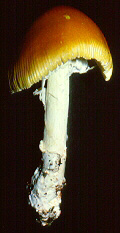
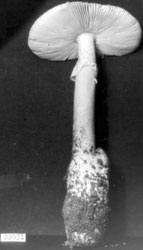
Amanita arkansana Rosen [ image ]
[ page ]
A "Slender Caesar group" amanita. Cap fulvous, striate; stipe
white, possibly discoloring to fulvous below, with white annulus,
with white saccate volva covering one-third to one-half of stipe.
The species is known from the
central Appalachians south to Florida and the Gulf Coast.
Spores: [260/12/7] (7.0-) 7.7 - 11.4 (-15.0) x (5.6-) 6.0 - 8.0 (-10.2)
µm, (L = 8.0 - 9.9 (-11.1) µm; L’ = 9.1 µm;
W = (6.3-) 6.5 -7.4 µm; W’ = 6.9 µm; Q = (1.10-) 1.18 -
1.53 (-1.69); Q = 1.22 - 1.38 (-1.50); Q’ = 1.31).
Known from Horse Cove, just outside park ca. Highlands, NC:
H-22051.
-
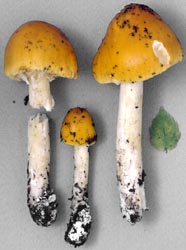
Amanita banningiana Tulloss nom prov. [ image ]
[ page ]
A "Slender Caesar group" amanita. Cap yellow at first, becoming brown-orange to brown from disc outward during expansion, with white volval sac rather small compared to other species of the group. The annulus is pale yellow and very similar to the color of the stipe and its decorations. Spores: [274/14/11] (7.5-) 8.4 - 11.9 (-15.0) × (5.2-) 5.9 - 7.8 (-9.8) µm, (L = 8.9 - 10.6 (-11.5) µm; L’ = 10.0 µm; W = 6.3 - 7.0 (-7.3) µm; W’ = 6.7 µm; Q = (1.14-) 1.33 - 1.71 (-2.14); Q = 1.39 - 1.61 (-1.69); Q’ = 1.49). Known in the central Appalachians from 2006 NAMA Regional Foray, at Wildacres, NC; however, no collection was retained. The range extends from the northern midwest USA throughout the NE states. The central Appalachians are as far south as the species is known to occur at present.
-
Amanita cokeriana Singer [ page ]
Pileus whitish, sometimes Tilleul buff or Vinaceous buff over disc. Stipe annulate with saccate volva. Syntypes (when they can be located) will be from South Carolina and Florida. No illustration is known to RET. Spores: 11 - 14.5 × 5.5 - 7.5 µm, with Q' approx. 1.95.
-
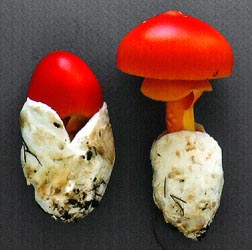
Amanita jacksonii Pomerl. [image]
[page ]
[≡Amanita umbonata Pomerl. non (Sumst.) Sartory & L. Maire; ≡Amanita caesarea var. americana Pomerl.;
= Amanita tullossii Guzmán & Ramírez-Guillén]
This species, another member of the Slender Caesar group, occurs from southern Canada to the cloud forests of the Sierra Madre Orientale in Mexico.
Spores: [317/15/11] (7.0-) 7.8 - 10.0 (-12.1) × (5.2-) 6.0 - 7.5 (-8.7) µm, (L = (8.1-) 8.4 - 9.5 µm; L’ = 8.8 µm; W = (6.0-) 6.3 - 7.3 µm; W’ = 6.7 µm; Q = (1.11-) 1.20 - 1.52 (-1.63); Q = 1.25 - 1.40 (-1.42); Q’ = 1.32).
[TENN (HPL)]
Cataloochee Valley, tr. near Fungus-1 transect [RET (u.d.)] FU-0150, FU-0229
-
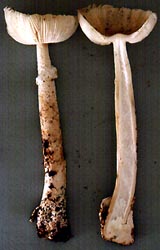
Amanita murrilliana Singer [ image ]
[ page ]
[≡Venenarius gemmatus var. volvatus Murrill]
Another member of the Slender Caesars Group, but lacking the bright colors of many other taxa in that group that appear in this list. The cap of this species is cream to whitish with a brownish center. Spores: [204/9/7] (8.5-) 9.5 - 12.6 (-13.6) × (5.6-) 6.4 - 8.4 (-9.2) µm, (L = 10.4 - 11.8 µm; L’ = 11.2 µm; W = 6.6 - 7.9 µm; W’ = 7.4 µm; Q = (1.23-) 1.32 - 1.74 (-1.88); Q = 1.43 - 1.58; Q’ = 1.51).
?Cherokee Orchard, Rainbow Falls Tr. [RET (u.d.)] RET 7-12-04-J
?Grotto Falls Tr. [RET (u.d.)] RET 7-12-04-R
-
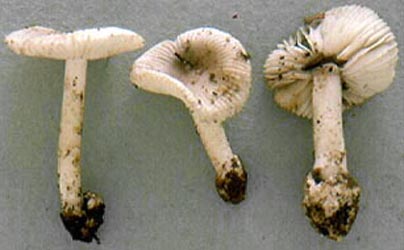
Amanita pachysperma G. F. Atk. [image]
[page]
Species described from Blowing Rock, NC. Similar entity known from Norris, TN. Differences seem to be white pubescence on
cap (could have been overlooked in protologue), size (too short), and shape of spores (too broad). Spores: [204/10/5] (9.5-) 10.5 - 16.2 (-20.0) ×
(6.0-) 7.5 - 10.5 (-12.5) µm, (L = (11.3-) 11.7 - 14.5 µm; L’ = 13.1 µm; W = (8.1-) 8.6 - 9.7 µm; W’ = 9.0 µm;
Q = (1.12-) 1.26 - 1.75 (-2.10); Q = (1.30-) 1.31 - 1.64; Q’ = 1.48). H-25691 is immature, which might account for observed differences.
H-25691, ?H-24432 (n.v.)
-
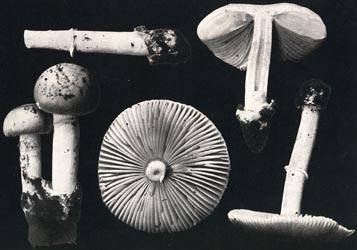
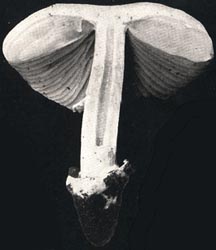
Amanita recutita sensu Coker [image]
[page]
[TENN (HPL)]
Originally described from Photographs by W. C. Coker from Coker (1917).
Described from Chapel Hill material. Volva reportedly rather soft and thick, breaking off at about the surface of the
substrate. Pileus said to be tan with sordid-rose tints with rather short marginal striations. The small ring on the
stipe is fragile and is lost in some recently collected material thought to belong to the present taxon. One of the most
narrow-spored North American taxa in sect. Caesareae. Spores: [77/4/2] (9.0-) 10.0 - 13.5 (-14.5) × (5.6-) 5.8 - 7.2 (-9.5) µm,
(L = 10.9 - 12.9 µm; L’ = 11.8 µm; W = 6.1 - 6.8 µm; W’ = 6.5 µm; Q = (1.56-) 1.62 - 2.0 (-2.57); Q = 1.73 - 1.89;
Q’ = 1.80).)
-
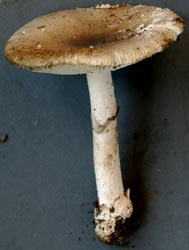
Amanita spreta (Peck) Sacc. [ image ]
[ page ]
This species is known for its graying annulus, its proportionally small volval sac, and its ellipsoid to elongate spores. The cap can be quite pale
at first and develops pigment in the gray to brown range. Spores: [134/7/7] (7.7-) 9.4 - 13.1 (-15.5) × (5.2-) 5.9 - 7.8 (-9.0) µm,
(L = 9.9 - 12.4 µm; L’ = 11.4 µm; W = 6.2 - 7.3 µm; W’ = 6.9 µm; Q = (1.40-) 1.48 - 1.83 (-2.04); Q = 1.60 - 1.76;
Q’ = 1.65).
Deep Crk. Ranger Stn. [RET (u.d.)] RET 7-19-06-E (=TFB 13297)
-
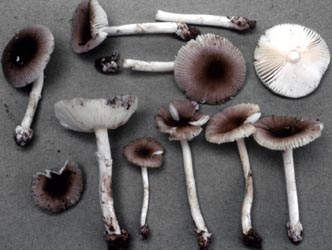
Amanita virginiana (Murrill) Murrill [ image ]
[ page ]
This small, brown, annulate species is so short that it may remain after a lawn in which it grows is mowed. It is largely associated with mature
(even very old) oaks. Spores: [940/47/18] (9.1-) 11.5 - 15.0 (-20.5) × (6.5-) 8.5 - 11.2 (-15.5) µm, (L = (11.7-) 12.3 - 14.0 (-14.1) µm;
L’ = 13.2 µm; W = (9.1-) 9.2 - 10.5 (-10.9) µm; W’ = 9.9 µm; Q = (1.07-) 1.16 - 1.52 (-1.89); Q = (1.16-) 1.21 - 1.42 (-1.55);
Q’ = 1.33).
Alum Cave trailhead [RET (u.d.)] RET 7-13-04-G
?Heintooga Rd. & Rough Fork Tr., Polls Gap [RET (u.d.)] FU-0645
?Heintooga Rd. & Rough Fork Tr., Polls Gap [RET (u.d.)] FU-0646.
-
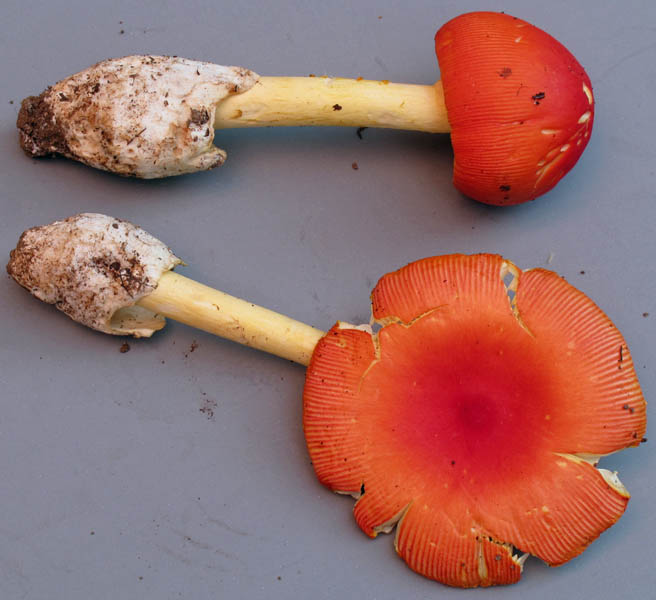
Amanita sp-AR01 Tulloss cryptonom. temp. [ image ]
[ page ]
Spores: [60/3/1] (8.0-) 8.6 - 11.0 (-19.2) × (5.7-) 6.0 - 7.4
(-8.0) µm, (L = 9.4 - 9.7 µm; L’ =
9.6 µm; W = 6.5 - 6.7 µm; W’ = 6.6 µm;
Q = (1.31-) 1.36 - 1.58 (-2.40); Q = 1.44 -
1.48; Q’ = 1.45).
-
Amanita sp-Hesler-22501 Tulloss cryptonom. temp.
[ image ]
[ page ]
The cap of this species is described as fulvous. The known specimen
was found near Highlands, NC. Spores: [20/1/1] (9.6-) 9.9 - 14.0
(-14.5) × (6.8-) 6.9 - 8.5 (-8.0) μm, (L = 11.1 μm; W
= 7.4 μm; Q = 1.37 - 1.65 (-1.68); Q = 1.50).
-
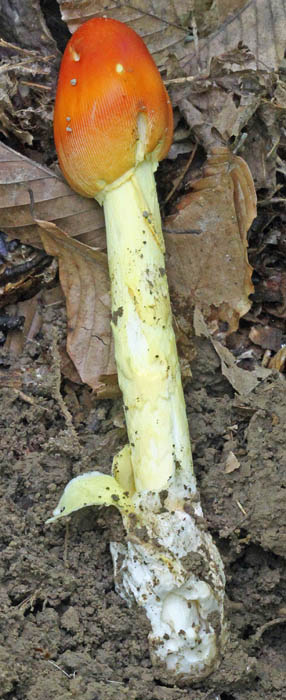
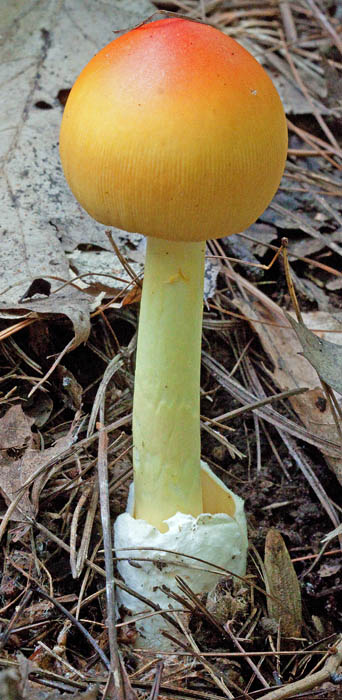
Amanita sp-W15 Tulloss and Sanchez-Ramirez cryptonom. temp.
[ image ]
[ page ]
One of several taxa distinguished morphologically or genetically with
an orange to red-orange cap center and yellowish cap margin.
Spores: data unavailable.
-
[ top ]
[skip section] [top of previous section]
Amanita section Vaginatae
[16 known from park of 23+ probable]
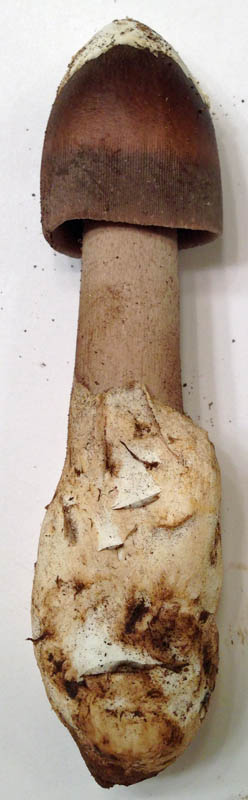
Amanita albemarlensis Tulloss & Kudzma nom. prov.
[ image ] [page ]
u.d.
Spores:
-
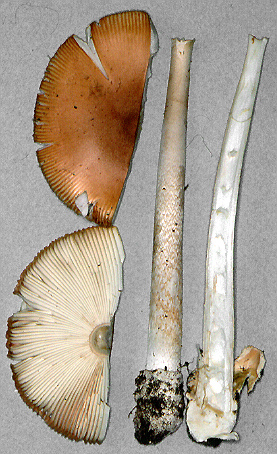
Amanita americrocea Tulloss nom. prov.
[ image ] [page ]
Spores: [97/5/4] (7.4-) 8.3 - 12.5 (-20) × (6.8-) 7.2 - 11.5
(-14.5) μm, (L = 8.8 - 9.8 (-11.4) μm;
L' = 9.9 μm; W = 7.9 - 9.1 (-10.0) μm;
W' = 8.9 μm; Q = (1.02-) 1.03 - 1.22 (-1.36);
Q = 1.07 - 1.15; Q' = 1.11).
-
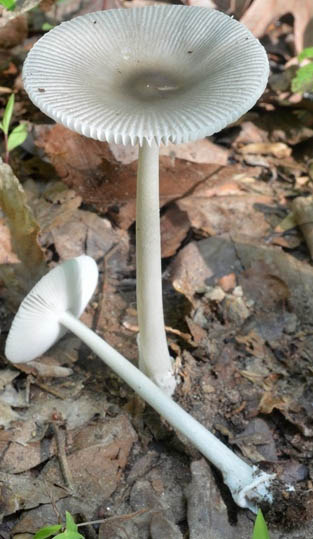
Amanita batonrougensis Tulloss, Kudzma & Wiedenf. nom. prov.
[ image ] [page ]
u.d.
Spores: [70/3/2] (8.4-) 8.9 - 10.5 (-11.0) × (5.7-) 6.1 - 8.0 (-8.5) μm, (L = 9.4 - 9.6 μm; L' = 9.5 μm; W = 6.5 - 7.0 μm; W' = 6.8 μm; Q = (1.19-) 1.24 - 1.52 (-1.72); Q = 1.34 - 1.40: Q' = 1.37)
-
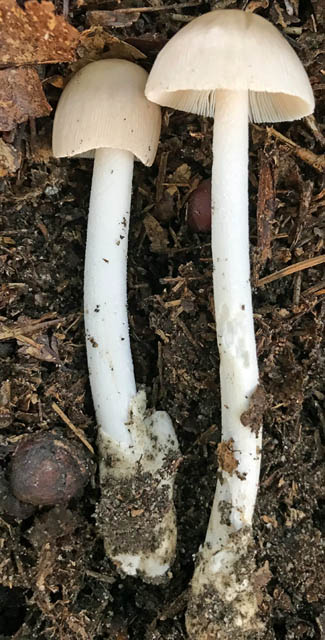
Amanita bensonensis Tulloss & S. D. Russell nom. prov.
[ image ] [page ]
u.d.
Spores:
-
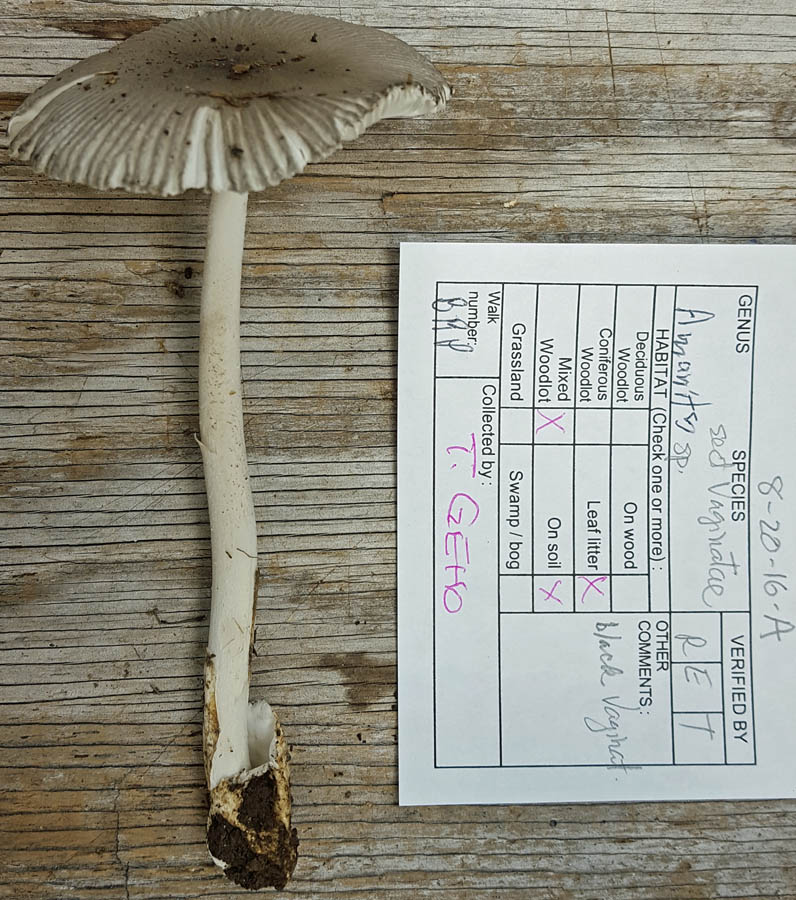
Amanita blueridgensis Tulloss & S. D. Russell nom. prov.
[ image ] [page ]
u.d.
Spores:[20/1/1] (8.7-) 9.0 - 11.5 (-12.4) × (6.3-) 6.5 - 9.0 (-9.3) μm, (L = 10.3 μm; W = 7.8 μm; Q = (1.14-) 1.20 - 1.50 (-1.57); Q= 1.33)
-
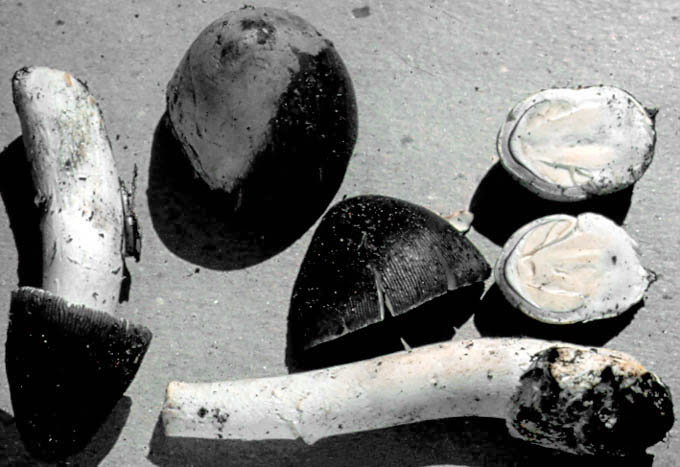
Amanita cacaina Tulloss nom. prov.
[ image ]
[page ]
Spores: [15/1/1] 8.7 - 10.8 (-11.9) × (7.3-) 8.7 - 9.1
(-10.8) µm, (L = 10.0 µm; W = 8.9 µm;
Q = 1.03 - 1.20 (-1.23); Q = 1.12).
-
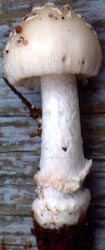
Amanita cremeosorora Tulloss nom. prov.*
[ image ] [page ]
=Amanita sp-S03 Tulloss cryptonom. temp.
Rather small fruiting body with exannulate stipe and white cupulate
volva. Internal limb of volva & (sometimes) part of
external limb separated from cupulate volva by strangulate zone.
Pileus is white to off-white to cream with marginal
striae and bears small patches or warts of volva concolorous with those
on the stipe base. Spores: [65/3/3] (8.0-) 8.6 - 10.8 (-11.6) × (7.0-) 8.0 -
10.0 (-11.0) µm, (L = 9.6 - 10.0 µm;
L' = 9.8 μm; W = 8.9 - 9.4 µm;
W' = 9.1 μm; Q = 1.03 - 1.14 (-1.17);
Q = 1.06 - 1.08); Q' = 1.08).
Cades Cove, loop road, Tulloss 9-27-06-C [RET u.d.; TENN).
-
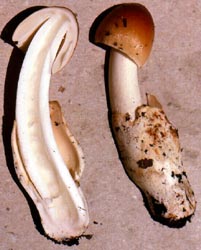
Amanita fulva group.
[ image ]
[ page ]
In the present region, this group includes at least two of at least four
very similar
taxa known from eastern North America: A. fulva (link above),
A. carolinensis,
A. sp-amerifulva01, and
A. sp-amerifulva02.
Spores of A. fulva: [300/13/10] (9.0-) 10.0 - 12.5 (-19.3)
× (8.2-) 9.3 -
12.0 (-15.5) µm, (L = 10.6 - 12.0 (-12.3) µm;
L’ = 11.2 µm; W = 9.8 - 11.4 (-11.6)
µm; W’ = 10.6 µm; Q = 1.0 - 1.11 (-1.25);
Q = 1.05 - 1.08 (-1.09); Q’ = 1.06).
[TENN (HPL)]
Cades Cove, Picnic Area [RET (u.d.)] RET 9-27-06-G
?Cataloochee Valley [RET (u.d.)] FU-0333, FU-0339
Deep Crk. site #3 [TENN (u.d.)] ?? (=TFB 13300)
Fork Ridge trailhead [RET (u.d.)] 7-13-04-D
?Grotto Falls Tr. [RET (u.d.)] RET 7-12-04-X
Indian Gap [RET (u.d.)] RET 7-13-04-E, 7-13-04-L
-
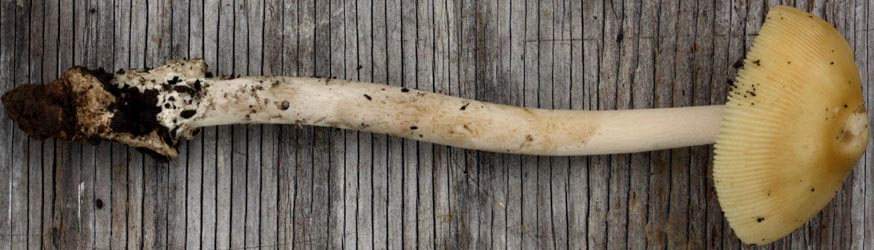
Amanita justicei Tulloss & Kudzma nom. prov.
[ image ] [page ]
u.d.
Spores: [40/2/2] (7.6-) 9.6 - 11.4 (-12.3) × (7.0-) 8.6 - 10.3 (-11.0) μm, (L = 10.4 μm; L' = 10.4 μm; W = 9.3 - 9.5 μm; W' = 9.4 μm; Q = (1.03-)1.05 - 1.16 (-1.23); Q = 1.09 - 1.11; Q' = 1.10)
-
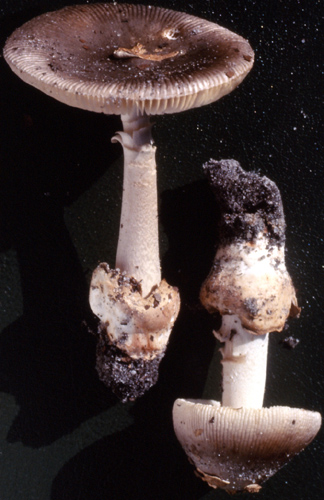
Amanita longicuneus Tulloss, Kudzma & K. W. Hughes nom. prov.
[ image ] [page ]
u.d.
Spores:[40/2/2] (10.2-) 10.5 - 12.2 (-12.5) ×
(8.2-) 9.0 - 12.0 (-14.0) µm,
(L = 11.2 - 11.4 µm; L’ = 11.3 µm;
W = 10.5 - 10.6 µm; W’ = 10.6 µm;
Q = (1.02-) 1.03 - 1.11 (-1.14);
Q = 1.05 - 1.08; Q’ = 1.07)
-
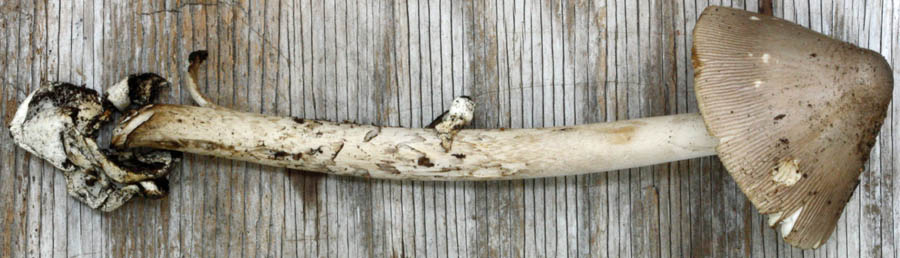
Amanita penetratrix Tulloss & Kudzma nom. prov.
[ image ] [page ]
u.d.
Spores:[60/3/3] (8.8-) 9.1 - 12.2 (-14.5) × (7.4-) 8.2 - 11.0 (-13.6) μm, (L = 10.2 - 11.2 μm; L' = 10.6 μm; W = 9.0 - 10.1 μm; W' = 9.5 μm; Q = (1.04-) 1.05 - 1.25 (-1.34); Q = 1.09 - 1.16; Q' = 1.12)
-
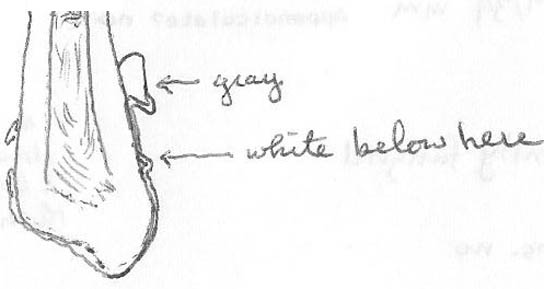
Amanita petersenii Tulloss
cryptonom. temp.*
[ image ] [ page ]
Pileus 78 mm wide, brownish gray with brown disc, virgate for most of
radius, subplanar, umbonate, tacky; context white with a thin grayish
line under pileipellis (lens), 4.5 mm thick at stipe, thinning evenly for
0.8 radius, then a membrane to margin; margin striate (0.5R),
nonappendiculate; universal veil absent. Lamellae free, without
decurrent line on stipe apex, close(?),
off-white in mass and in side view, 4.5 - 5.5 mm wide, with fimbriate
margin (lens); lamellulae truncate to subattenuate to subtruncate.
Stipe 140 × 9 mm (with stipe base inserted up to 80 mm in substrate),
pallid, decorated with a pale gray pulverulence in upper 30 mm, with
darker gray fibrils below, with membranous gray narrow patches in lower
half, cylindric, flaring at apex, very fragile; context pale
grayish white, not changing when cut or bruised, stuffed with white
cottony material that bruises ochraceous, with central cylinder 3 mm
wide; exannulate; universal veil as flimsy saccate volva, submembranous
and crumbling especially in upper half of limbs, 30 mm from base to
highest point on limb, up to 17 mm wide, gray in upper half, white in
lower half, collapsing. Known from Blue Valley, Macon Co., North
Carolina. Spores: [20/1/1] (9.1-) 9.5 - 10.8 (-11.0) × (8.0-)
8.5 - 10.0 (-10.5) µm, (L = 10.1 µm; W = 9.2 µm; Q =
1.05 - 1.16 (-1.19); Q = 1.11).
?Cades Cove, Loop Rd. ("stop 1") [TENN (u.d.); RET (u.d.)] RET
9-28-06-B, ?? (=TFB13424)
-
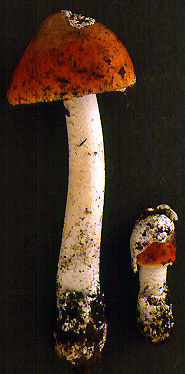
Amanita pseudocrocea Tulloss nom. prov. [image] [ page ]
Spores: [120/5/4] (7.8-) 8.6 - 10.8 (-21) × (6.4-) 7.2 - 9.5
(-17.8) µm, (L = 9.2 - 10.1 µm; L’ =
9.7 µm; W = 7.5 - 9.2 µm; W’ = 8.4 µm;
Q = (1.05-) 1.06 - 1.30 (-1.59); Q = 1.10 -
1.20; Q’ = 1.15).
-
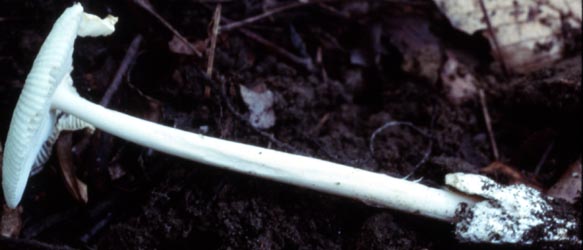
Amanita rasitabula Tulloss nom. prov.* [image] [ page ]
The taxon is often called A. vaginata var. alba which is a
European specoes and not to be expected in the US.
See A. cremeosorora as one taxon that might
have been included herein in the past. Spores: [47/3/3] (8.8-)
9.0 - 11.0 (-13.0) × (7.5-) 8.0 - 10.0 (-10.3) µm, (L = 9.6 -
10.4 µm; L' = 9.9 µm; W = 8.6 - 9.2 µm; W' = 8.9 µm; Q = (1.0-)
1.05 - 1.22 (-1.27); Q = 1.10 - 1.12; Q' = 1.11).
Cades Cove [TENN (HN)] H-22054, H-30272
-
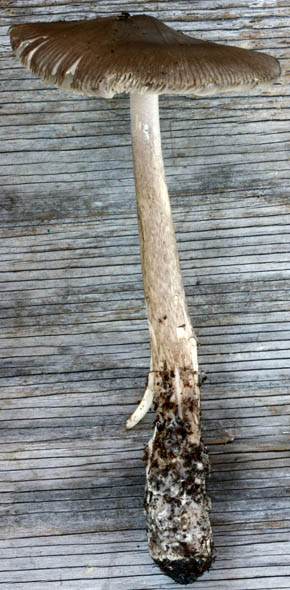 Amanita rhacopus
Lamoureux nom. prov.* [ image ]
[ page]
Amanita rhacopus
Lamoureux nom. prov.* [ image ]
[ page]
This species is one of the taxa that were mislabeled A. ceciliae
for many years. Spores: [80/4/4] (9.3-) 9.6 - 12.0 (-12.2) × (8.5-) 9.0 -
11.0 (-12.0) µm, (L = 10.0 - 11.3 µm;
L’ = 10.7 µm; W = 9.4 - 10.5 µm;
W’ = 10.0 µm; Q = (1.02-) 1.04 - 1.12 (-1.14);
Q = 1.05 - 1.08; Q’ = 1.06).
Fork Ridge trailhead, Norvell LLN2040713-01.
-
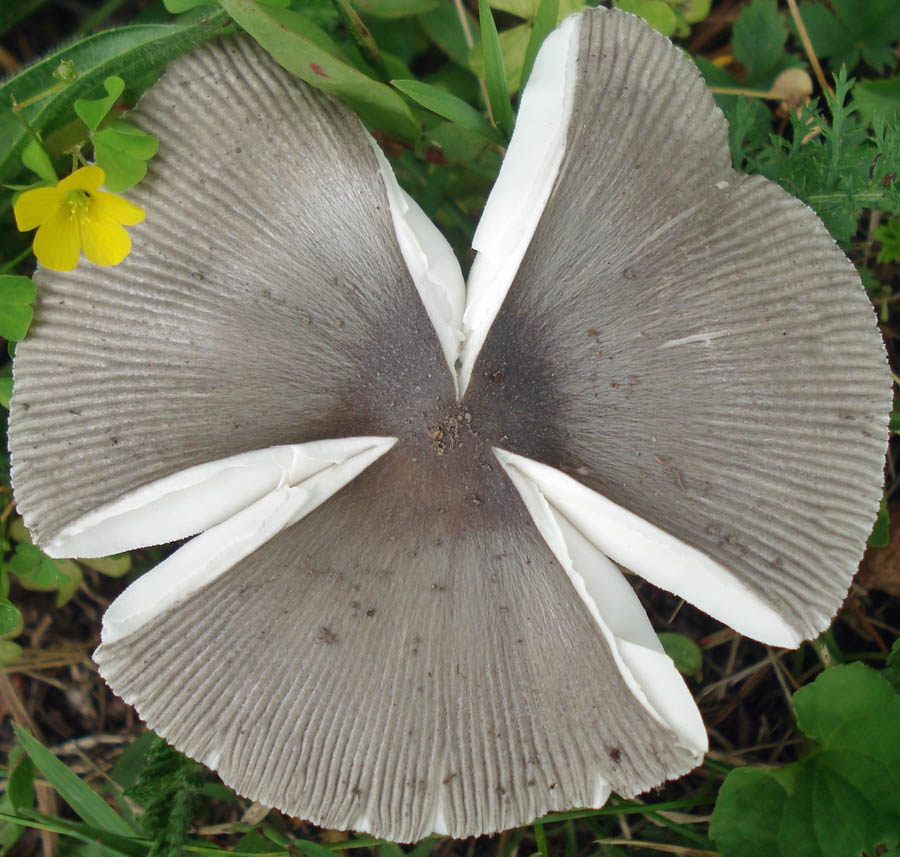
Amanita rooseveltensis Tulloss, Kudzma & Wasilewski nom. prov.
[ image ] [page ]
u.d.
Spores:[20/1/1] 7.7 - 10.5 (-12.6) × (6.6-) 7.0 - 8.7 (-9.4) μm, (L = 9.9 μm; L'= 9.9 μm; W = 7.8 μm; W' = 7.8 μm; Q = (1.05-) 1.13 - 1.36 (-1.40); Q = 1.27; Q' = 1.27)
-
Amanita scutum
[ image ] [page ]
u.d.
Spores:?
-
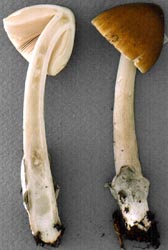
Amanita sinicoflava Tulloss [image ] [ page]
This species is named for its olivaceous yellow cap (the color of Mandarin robes in imperial China. The submembranous volva becomes gray from the top
down, often before the cap is fully expanded. Spores: [645/33/25] (8.0-) 9.1 - 12.1 (-15.4) × (7.0-) 8.4 - 11.5 (-15.4) µm, (L = (9.5-) 9.8 - 11.4 (-11.7) µm; L’ = 10.6 µm; W = (8.7-) 9.0 - 10.6 (-10.8) µm; W’ = 10.0 µm; Q = 1.0 - 1.14 (-1.26); Q = 1.04 - 1.09 (-1.10); Q’ = 1.06).
Cherokee Orchard [RET (u.d.)] RET 7-12-04-AG
Deep Crk. Ranger Stn. [TENN (u.d.)] ?? (=TFB 13294)
-
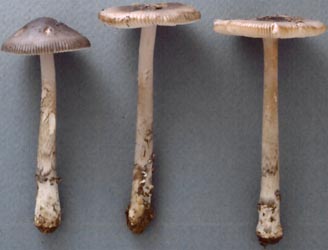
Amanita
texasorora Tulloss nom. prov.*
[image ]
[ page]
The cap color range may overlap that of A. rhacopus (above).
Spores: [40/2/2] (9.8-) 10.0 - 12.0 (-13.1) × (9.1-) 9.5 -
11.5 (-12.9) µm, (L = 11.2 - 11.3 µm;
L' = 11.0 µm; W = 10.2 - 10.7 µm;
W' = 10.4 µm; Q = 1.02 - 1.09 (-1.10);
Q = 1.04 - 1.07; Q' = 1.05).
Huskey Gap Tr. off Newfoundgap Rd. [TENN 061604] (TFB 13336)
-
Amanita vaginata sensu lato
There are so many taxa that could fall under this heading that it will probably end up in a list of "uninterpretable" names. The name in the
strictest sense is a taxon probably limited to Europe; however, application of the name by European authors is not consistent.
[TENN (HPL)]
-
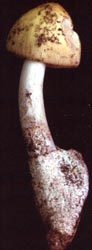
Amanita williamsiae
Tulloss nom. prov.
[image ]
[ page]
Spores: [130/6/5] (9.5-) 10.5 - 14.0 (-15.7) × (8.2-)
9.0 - 11.5 (-14.0) µm, (L = 11.0 - 13.4 µm;
L' = 11.5 μm;
W = 9.8 - 11.4 µm; W' = 10.1 μm;
Q = (1.03-) 1.05 - 1.25 (-1.34); Q = 1.11 -
1.18; Q' = 1.13).
-
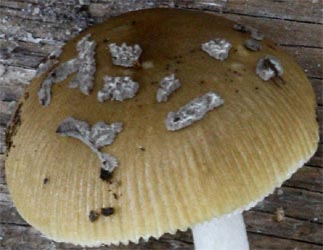
Amanita xanthomitra
Tulloss nom. prov.*
[image ]
[ page]
Spores: [140/7/4] (7.7-) 8.7 - 11.9 (-13.6) × (7.3-) 8.4 -
11.5 (-13.3) µm, (L = 9.5 - 11.0 µm;
L’ = 10.1 µm; W = 9.1 - 10.6 µm;
W’ = 9.6 µm; Q = 1.0 - 1.09 (-1.19);
Q = 1.03 - 1.08; Q’ = 1.05).
Cataloochee sector, [RET u.d.]
-
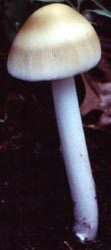
Amanita sp-21 Tulloss cryptonom. temp. [ image ] [ page ]
Zonate pileus (3 or 4 zones alternating cream to olivaceous tan, with white margin (during expansion?). Stipe white and exannulate. Volva
saccate and white. Currently known in northeastern USA as far south as West Virginia. Spores: [40/2/2] 8.0 - 10.1 × 7.7 - 9.8 µm, (L = 9.1 - 9.3 µm; L’ = 9.2 µm; W = 8.7 - 9.0 µm; W’ = 8.9 µm; Q = 1.0 - 1.08 (-1.11); Q = 1.03 - 1.04; Q’ = 1.04).
-
Amanita sp-GSM01 Tulloss cryptonom.
temp.*
Pale gray cap, exannulate stipe, very narrow spores (Q=1.71).
ca. Gatlinburg in park [TENN (HN & RET)] H-21417
-
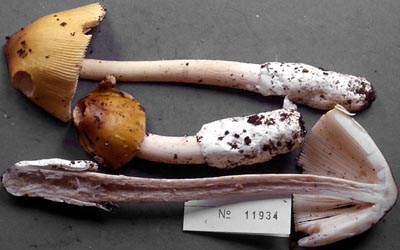
Amanita sp-GSM02 Tulloss cryptonom. temp.* [ image ] [ page ]
Cap honey yellow with Saccardo's umber disc, umbonate, striate; stipe exannulate, cream buff; volva membranous, white. Photo used with permission of Hughes Lab ATBI project. Spores: ??
?? [TENN (u.d.)] ?? (=TFB 11934)
?? [TENN (u.d.)] ?? (=TFB 13298)
Grotto Falls Tr. [RET (u.d.)] RET 7-12-04-S
Schoolhouse Gap tr. head [?? (u.d.)] ?? (= TFB 12727)
-
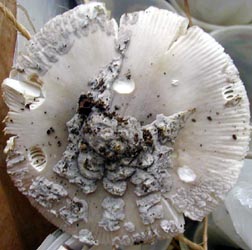
Amanita sp-GSM03 Tulloss cryptonom. temp.* [ image ] [ page ]
Pileus dark gray over disc, pale gray elsewhere, relatively short marginal striations, with very thick floccose-felted warts confluent; stipe exannulate with gray surface layer breaking up into dark fibrils from handling; volva originally saccate, but some breaking up into patches & becoming
gray to dark gray. Having some similarity to A. sp-N28 Tulloss cryptonom. temp.. Spores: ??
Cherokee Orchard, Rainbow Falls Tr. [RET (u.d.)] RET 7-12-04-G
-
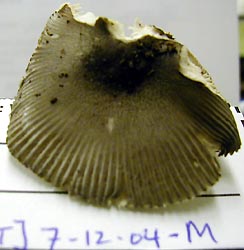
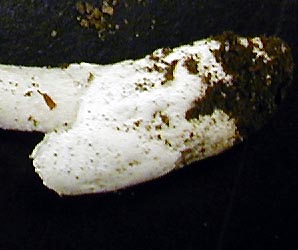
Amanita sp. GSM04 Tulloss cryptonom. temp.
* [ image ] [ page ]
Small species with very dark gray cap, striate, without volval remnants, but sometimes with distinct whitish pruinosity or frosty appearance; stipe white, exannulate, and finely pulverulent; volva saccate, white, sometimes
staining pale orange.
Cherokee Orchard, Rainbow Falls, Tr. [RET (u.d.)] RET 7-12-04-M
Grotto Falls trailhead [RET (u.d.)] RET 7-12-04-AE
-
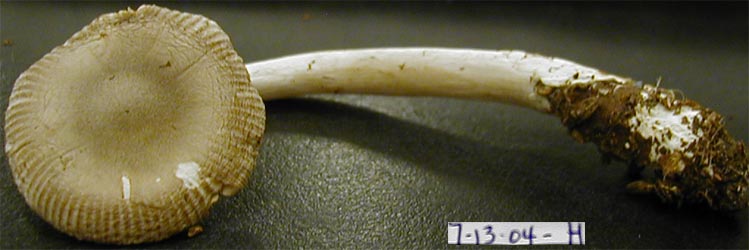
Amanita sp-GSM05 Tulloss cryptonom. temp.* [ image ] [ page ]
Small fruiting body with exannulate stipe & white saccate volva. Pileus is olivaceous gray becoming brownish gray with age, with paler
zone btwn. disc & marginal striations. The single specimen had a 25 mm wide pileus.
Alum Cave trailhead [RET (u.d.)] RET 7-13-04-H
-
(A) ??.
(B)
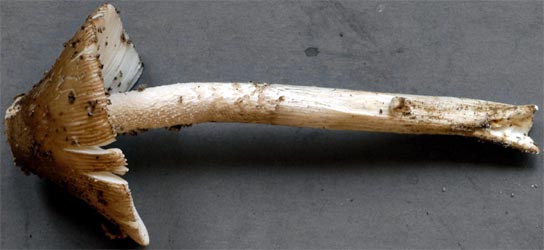
Amanita sp-GSM06A Tulloss cryptonom. temp.
*
Amanita sp-GSM06B Tulloss cryptonom. temp.
* [ image ]
[ page ]
(A) Pileus up to 90 mm wide, olive brown near margin, becoming more saturated toward disc, blackish brown to fuscous
black over disc, planar when expanded, umbonate, with striate sulcate margin. Lamellae white. Stipe whitish to near
"Tilleul Buff," powdery on upper half, with tawny olive fibrils on lower half, exannulate, about 150 × 12.5 mm, stuffed,
with saccate volva having dingy inner surface. Spores: [20/1/1] (9.6-) 10.0 - 12.4 (-14.5) × (8.4-) 8.8 - 10.6 (-12.8) µm, (L = 11.0 µm;
W = 9.6 µm; Q = (1.04-) 1.07 - 1.23; Q = 1.14).
Big Fork Ridge Tr., Cataloochee Cove [TENN; RET (u.d.)] 60679 (=TFB 12081)
(B) Second specimen similar (see petersenii), with powdery region on upper stipe distinctly grayish. Base of stipe damaged in sole specimen. Spores: [20/1/1] (9.0-) 9.2 - 11.6 (-13.2) × (8.0-) 8.2 - 10.0 (-11.2) µm, (L = 10.1 µm; W = 9.0 µm; Q = 1.08 - 1.14 (1.22); Q = 1.12).
Deep Creek Campgrd. [TENN; RET (u.d.] ?? (=TFB 13301)
-
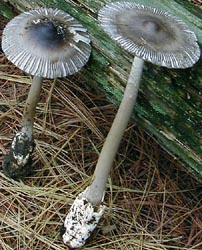
Amanita sp-GSM07 Tulloss cryptonom. temp.* [ image ] [ page ]
The pileus is zonate, with disc and area over marginal striations dark brown to fuligineous at maturity and with a brown intermediate zone. The region of the marginal striations may be quite pallid at first. The stipe is exannulate, often bearing dark fibrils and may turn entirely gray in age. The volva is saccate with a limbus internus placed well above the sac's point of attachment to the stipe. The height of the limbus internus is about 20% - 25% of the distance from its point of connection to the volval limb to the highest point of the sac. This species is known to the north as far as the Pine Barrens of southern New Jersey. Spores: [20/1/1] 12.3 - 14.5 (-15.5) × (11.1-) 11.7 - 13.1 (-13.7) µm, (L = 13.4 µm; L’ = 13.4 µm; W = 12.3 µm; W’ = 12.3 µm; Q = 1.04 - 1.13 (-1.19); Q = 1.09; Q’ = 1.09).
?Grotto Falls Tr. [RET (u.d.)] RET 7-12-04-V, 7-12-04-W
?? [TENN (u.d.)] 61168
-
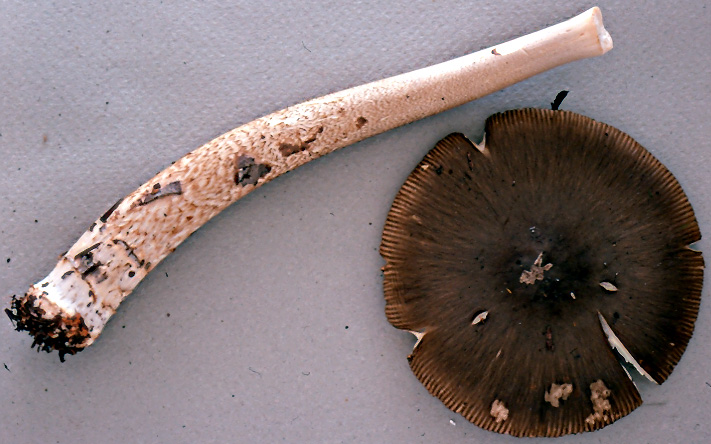 Amanita sp-N24
[ image ] [page ]
Amanita sp-N24
[ image ] [page ]
u.d.
Spores:[80/3/2] (8.2-) 9.0 - 14.0 (-15.5) × (8.0-) 8.5 - 13.5 (-15.0) µm, (L = 9.9 - 12.5 µm; L’ = 10.7 µm; W = 9.4 - 11.9 µm; W’ = 10.2 µm; Q = 1.0 - 1.10 (-1.22); Q = 1.05 - 1.06; Q’ = 1.05)
-
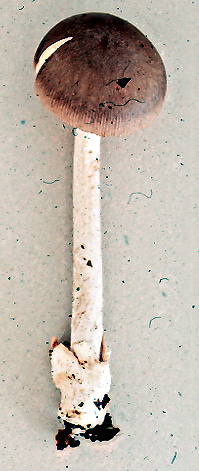 Amanita sp-N40
[ image ] [page ]
Amanita sp-N40
[ image ] [page ]
u.d.
Spores:[40/2/2] (10.0-) 10.2 - 13.2 (-13.8) × (9.2-) 9.5 - 12.5 (-13.2) µm, (L = 10.7 - 12.5 µm; L’ = 11.6?? µm; W = 10.1 - 11.9 µm; W’ = 1.06?? µm; Q = 1.02 - 1.09 (-1.11); Q = 1.05 - 1.06; Q’ = 1.05??)
-
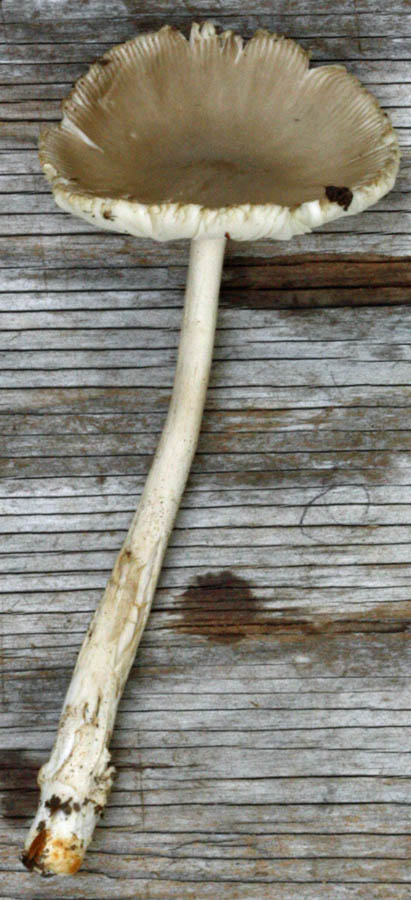 Amanita sp-N66
[ image ] [page ]
Amanita sp-N66
[ image ] [page ]
u.d.
Spores:[20/1/1] (8.6-) 8.8 - 10.6 (-12.6) × 8.0 - 9.5 (-12.5) μm (L = 8.4 μm; W = 8.6 μm; Q = (1.04-) 1.06 - 1.12 (-1.23); Q = 1.11)
-
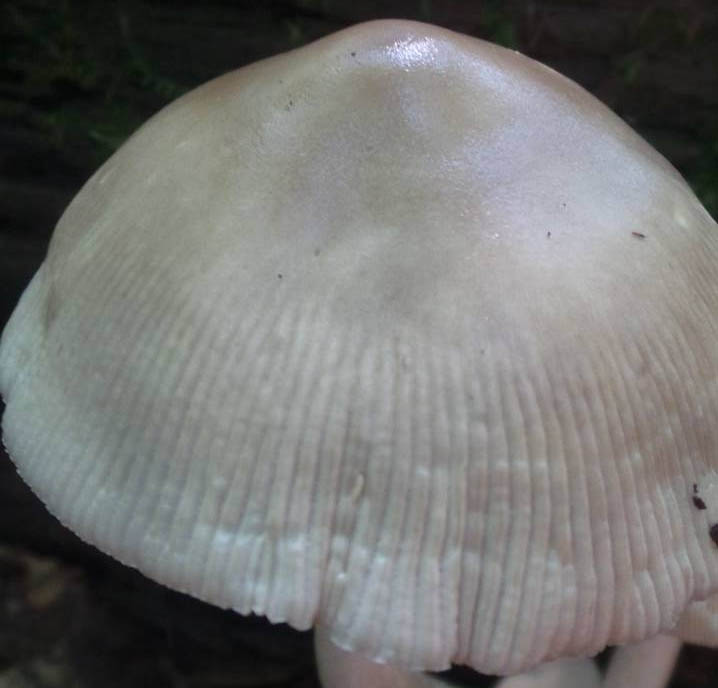 Amanita sp-N68
[ image ] [page ]
Amanita sp-N68
[ image ] [page ]
u.d.
Spores:
-
Amanita sp-S07 Tulloss cryptonom. temp. [ image ] [ page ]
Pileus 88 mm wide, yellowish-brown with olivaceous tint to the brown, campanulate to planoconvex, dry, dull; context white, unchanging when cut or bruised, 7 mm thick at stipe, thinning evenly to margin; margin striate (0.15 - 0.2R), nonappendiculate; universal veil absent. Lamellae free, without decurrent line on stipe, crowded, sordid tan in mass, sordid pale tan in side
view, unchanging when cut or bruised, 5 mm thick; lamellulae truncate. Stipe 215 × 14 mm, whitish, narrowing upward, surface fibrillose and longitudinally striate; context whitish, apparently unchanging when cut or bruised, stuffed with white cottony material, with 6 mm wide central cylinder; exannulate; universal veil as a saccate volva, white, leathery and rather tough, 39 mm from base to highest point of limb. Known from Roper Mtn. Park, Greenville Co., South Carolina. Spores: [40/1/1] (9.0-) 9.2 - 12.5 (-15.5) × (6.5-) 6.8 - 9.2 (-11.8) µm, (L = 10.1 µm; W = 7.9 µm; Q = (1.06-) 1.08 - 1.60 (-1.86); Q = 1.26).
-
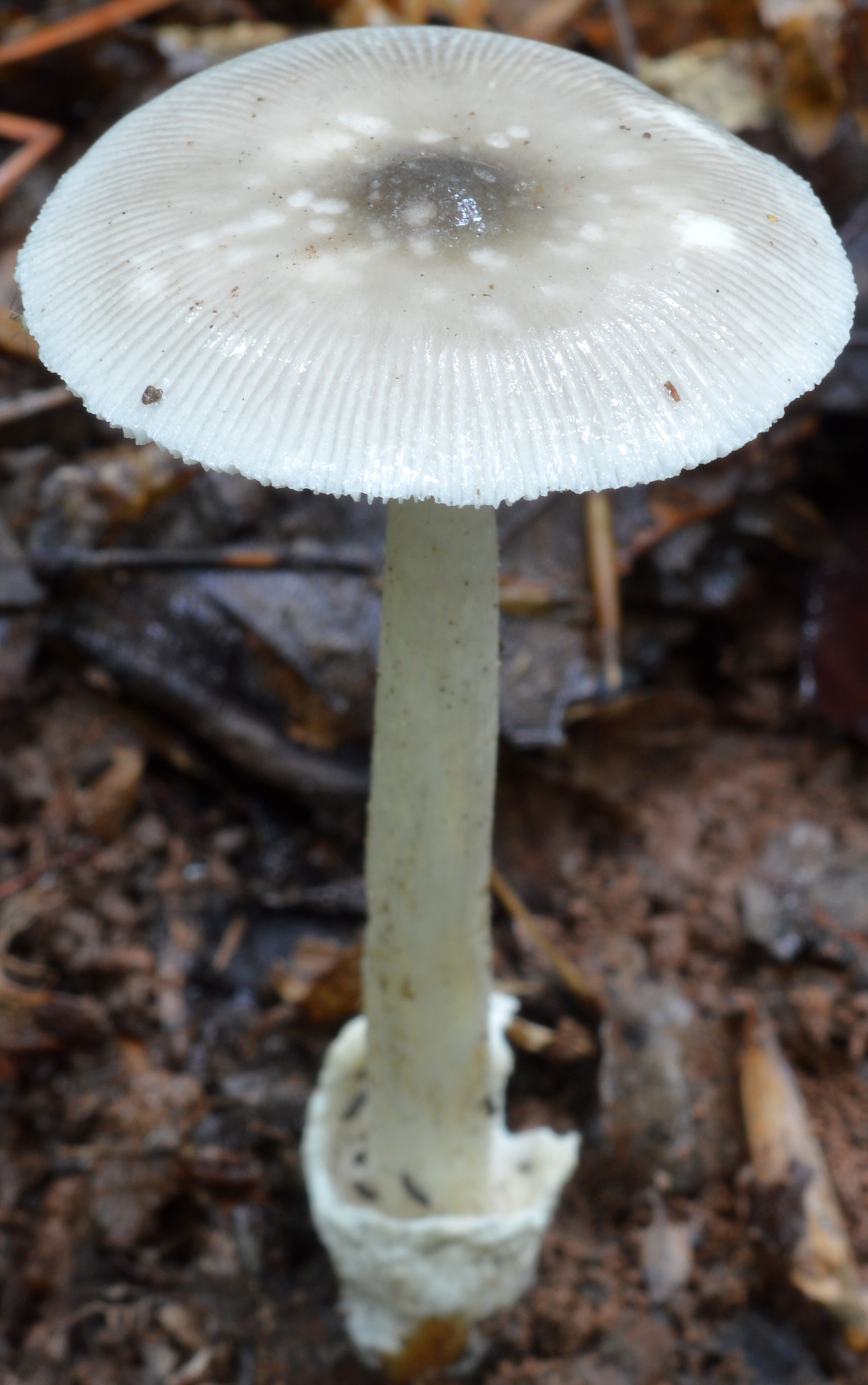 Amanita sp-S11
[ image ] [page ]
Amanita sp-S11
[ image ] [page ]
u.d.
Spores:
-
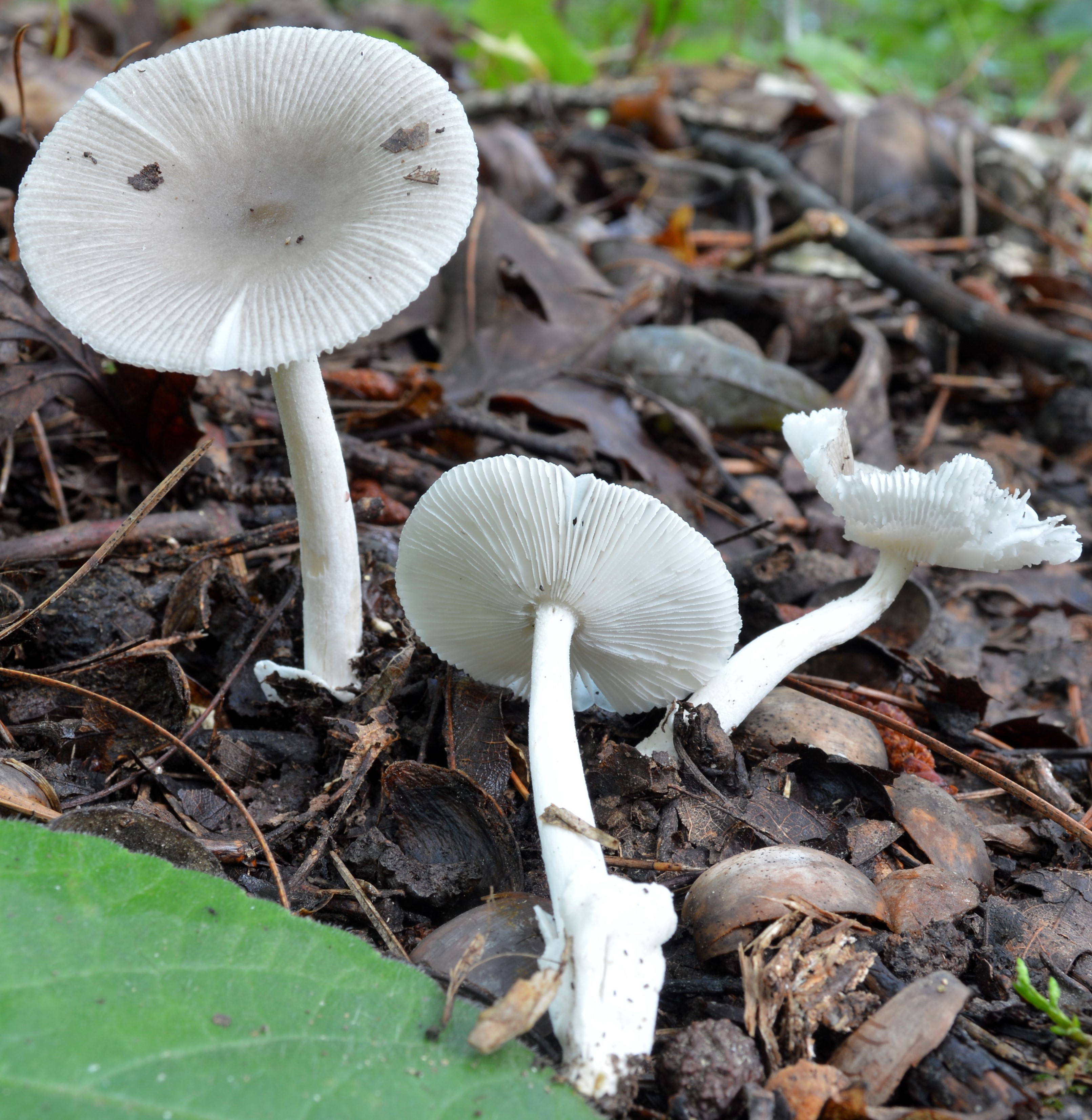 Amanita sp-S12
[ image ] [page ]
Amanita sp-S12
[ image ] [page ]
u.d.
Spores:
-
Amanita sp-S13
[ image ] [page ]
u.d.
Spores:
-
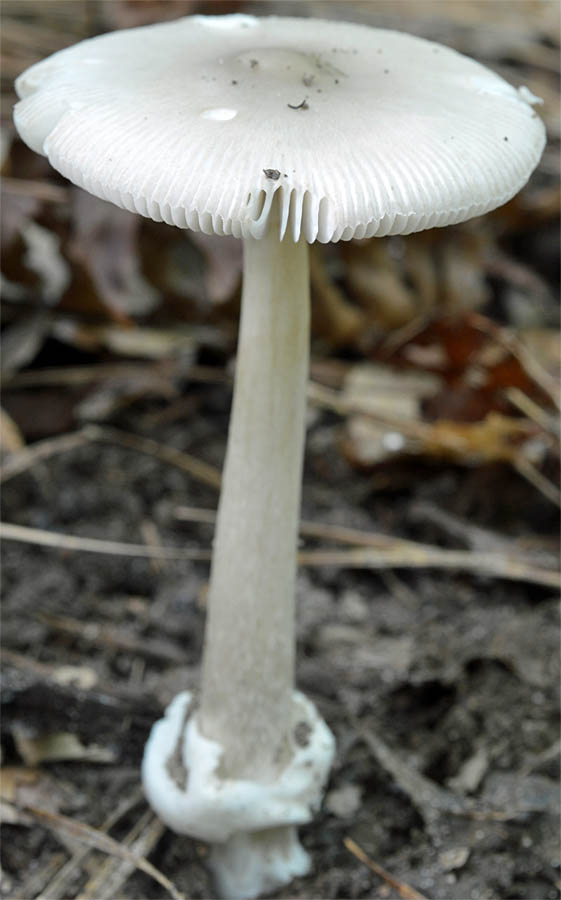 Amanita sp-S14
[ image ] [page ]
Amanita sp-S14
[ image ] [page ]
u.d.
Spores:[30/1/1] (8.3-) 8.5 - 10.0 (-12.2) × (7.2-) 7.4 - 8.7 (-10.1) μm, (L = 9.1 μm; W = 8.0 μm; Q = 1.07 - 1.25 (-1.28); Q = 1.13)
-
Amanita sp-S15
[ image ] [page ]
u.d.
Spores:
-
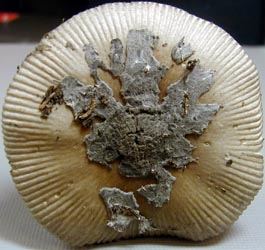
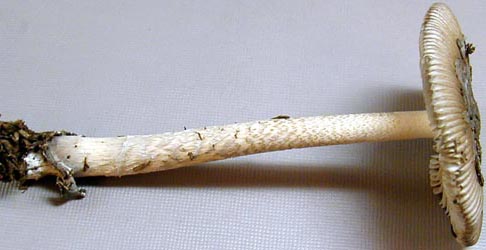
Amanita sp-V03 Tulloss cryptonom. temp.
* [ image ]
[ page ]
This is one of the taxa that for years was mislabeled A.
cecilieae. Spores: [50/2/2] (8.8-) 9.6 - 11.5 (-13.5) ×
(8.2-) 8.5 - 11.0 (-12.8) μm, (L = 10.6- 10.7 μm;
L' = 10.7 μm; W = 9.9 μm; W' =
9.9 μm; Q = (1.03-) 1.04 - 1.13 (-1.14); Q =
1.07 - 1.08; Q; = 1.08. So far as is
known, he range of this taxon is limited to the southeastern U.S.
Cataloochee Valley [RET (u.d.)] FU-0336
?Cherokee Orchard, Rainbow Falls Tr. [RET (u.d.)] RET 7-12-04-D
?Fork Ridge trailhead [RET (u.d.)] LN2040713-01
?Indian Gap [RET (u.d.)] RET 7-13-04-K
-
[top] [skip section] [top of previous section]
Amanita section Amidella
[5 known from park of 5+ probable]
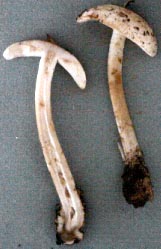
Amanita dolichopus Tulloss nom. prov. * [ image ] [ page ]
[=Amanitopis volvatus var. elongatus Peck]
Spores: [978/47/32] (7.0-) 8.8 - 12.5 (-24.0) × (4.0-) 4.9 - 6.2 (-10.0) µm, (L = (8.9-) 9.4 - 11.5 (-13.5) µm; L’ = 10.5 µm; W = (4.8-) 5.2 - 5.8 (-5.9) µm; W’ = 5.5 µm; Q = (1.36-) 1.59 - 2.30 (-3.33); Q = (1.64-) 1.70 - 2.12 (-2.26); Q’ = 1.91).
Balsan Mtn. Rd. [TENN (u.d.)] 61187 (= TFB 12727)
Cherokee Orchard, Rainbow Falls Tr. [RET (u.d.)] RET 7-12-04-C
-
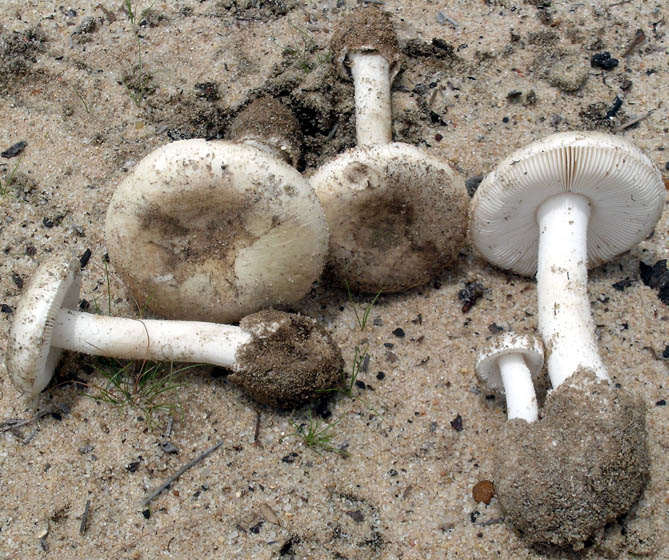
Amanita peckiana Kauffman in Peck [ image ] [ page ]
Basidiomes annulate at first, quickly exannulate, with context bruising and staining reactions relatively faint. Spores: [1995/96/77]
(7.1-) 9.7 - 15.0 (-26.6) × (3.4-) 4.2 - 6.8 (-9.2) µm, (L = (9.4-) 10.3 - 14.3 (-15.0) µm; L’ = 12.4 µm; W = (4.2-) 4.4 - 6.4 (-6.7) µm;
W’ = 5.4 µm; Q = (1.33-) 1.73 - 3.05 (-4.51); Q = (1.73-) 1.86 - 2.93 (-3.08); Q’ = 2.29).
?Cataloochee Valley [RET (u.d.)] FU-0260
Indian Gap [FLAS (u.d.)]
Laurel Falls [MICH (u.d.)]
-
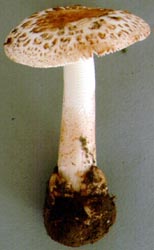
Amanita pseudovolvata Tulloss nom. prov.
* [image]
[ page ]
[=Amanita sp-41 Tulloss cryptonom. temp.]
Usually having a small basidiome, always with striations clearly visibile as cap emerges from volval sac. Spores:
[1317/65/54] (5.0-) 8.0 - 11.0 (-13.5) × (3.8-) 4.5 - 6.0 (-7.8) µm, (L = (7.6-) 8.5 - 10.6 (-11.0) µm; L’ = 9.6 µm;
W = (4.5-) 4.8 - 5.9 (-6.5) µm; W’ = 5.2 µm; Q = (1.11-) 1.52 - 2.16 (-2.76); Q = (1.42-) 1.64 - 2.04 (-2.14); Q’ = 1.85).
Cataloochee Valley [RET (u.d.)] FU-0265, FU-0332, FU-0341
Cherokee Orchard, Rainbow Falls Tr. [RET (u.d.)] RET 7-12-04-I
Indian Creek [MICH (u.d.)
-
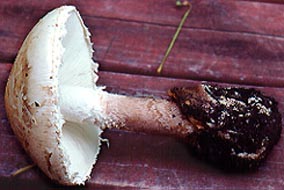
Amanita volvata(Peck) Lloyd [ image ]
[ page ]
Spores: [1223/61/45] (5.8-) 8.4 - 12.3 (-14.2) × (4.5-) 5.2 - 7.2 (-9.0) µm, (L = (8.6-) 9.0 - 11.8 (-12.4) µm; L’ = 10.3 µm;
W = (5.1-) 5.5 - 6.8 (-7.6) µm; W’ = 6.2 µm; Q = (1.16-) 1.35 - 1.94 (-2.45); Q = (1.39-) 1.48 - 1.93 (-2.02); Q’ = 1.65).
Cades Cove [L (u.d.)]
Heintooga Rd. & Rough Fork Tr., Polls Gap [RET (u.d.)] FU-0228
Kephart Prong Tr. [MICH (u.d.)]
-
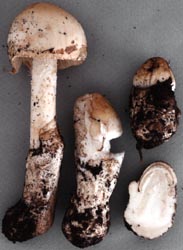
Amanita whetstoneae Tulloss nom. prov.* [ image ]
[ page ]
Spores: [1070/52/43] (7.0-) 8.8 - 12.0 (-14.1) × (4.2-) 4.8 - 6.5 (-8.2) µm, (L = (8.4-) 9.0 - 11.2 (-11.6) µm; L’ = 10.3 µm;
W = (4.7-) 5.0 - 6.1 (-6.8) µm; W’ = 5.5 µm; Q = (1.28-) 1.54 - 2.19 (-2.69); Q = (1.61-) 1.66 - 2.04 (-2.13); Q’ = 1.87).
Alum Cave trailhead (RET (u.d.) RET 7-13-04-A
N of Bryson City [MICH (u.d.)]
Grotto Falls trailhead [RET (u.d.)] RET 7-12-04-Y
Heintooga Road & Rough Fork Tr., Polls Gap [RET (u.d.)] FU-0648 to -0651
Indian Gap [FH (u.d.), TENN (u.d.)] H-19139, H-20964, H-20967
no locality [FH (u.d.)]
[ top ]
[ skip section ]
[top of previous section]
Amanita section Lepidella
[16 known from park of 29+ probable]
-
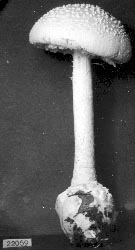
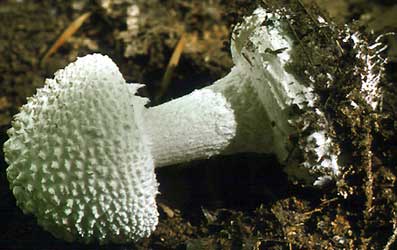 Amanita abrupta Peck [ image ]
[page]
Amanita abrupta Peck [ image ]
[page]
Spores: [97/4/4] (6.1-) 7.2 - 9.0 (-10.7) × (4.8-) 5.9 - 7.5 (-9.2) µm, (L = 7.9 - 8.5 µm; L’ = 8.1 µm; W = 6.1 - 6.8 µm;
W’ = 6.6 µm; Q = (1.07-) 1.10 - 1.40 (-1.61); Q = 1.17 - 1.32; Q’ = 1.23).
Cades Cove [TENN (HPL & HN)] H-26527
Cherokee Orchard, Rainbow Falls Tr. [RET (u.d.)] RET 7-12-04-H
-
Amanita altifissura Dav. T. Jenkins [ page ]
-
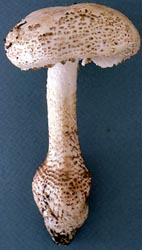
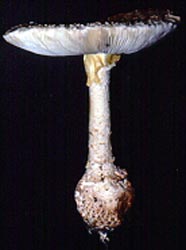
Amanita atkinsoniana Coker [ image ]
[page]
Note that the universal veil becomes brown and that warts of the u.v. can ring the stipe's basal bulb in its entirety. The partial veil can be lost or,
if it persists, will become slimy and yellowish with age. The range of this species extends from southern Quebec at least to the Carolinas.
Spores: [50/2/2] (8.0-) 8.7 - 10.5 (-13.0) × 5.9 - 7.7 (-8.5) µm, (L = 9.3 - 9.7 µm; L’ = 9.5 µm; W = 6.6 - 6.9 µm; W’ = 6.7 µm;
Q = (1.18-) 1.25 - 1.64 (-1.67); Q = 1.41; Q’ = 1.41).
-
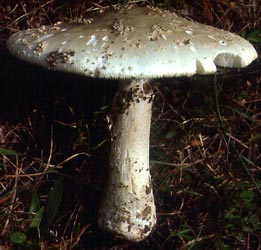
Amanita canescens Dav. T. Jenkins [ image ] [ page ]
The range of this species extends from at least Connecticut to the Gulf Coast. The partial veil is weakly attached; the stipe is often decorated with pale salmon to golden orange to pale orangish white fibrils especially after handling. Spores: [125/6/5] (6.5-) 7.5 - 10.8 (-12.0) × (4.5-) 4.8 - 6.0 (-6.8) µm, (L = 8.3 - 9.5 µm; L’ = 8.9 µm; W = 5.0 - 5.7 µm; W’ = 5.3 µm; Q = (1.35-) 1.46 - 1.94 (-2.16);
Q = 1.60 - 1.75; Q’ = 1.67).
-
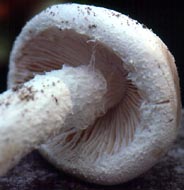
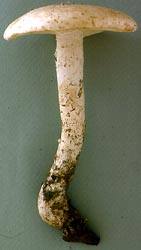
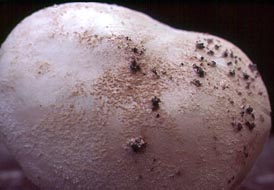
Amanita chlorinosma (Austin) Lloyd [ image ]
[ page ]
Characteristic of this species are the very disorganized microstructure of the universal veil, the presence of plentiful
large clamps at the bases of basidia, the persistently white or whitish color of the basidiome, and the size and shape of the spores.
The closest phenetic relative is A. tephrea. Spores: [85/4/4] (7.5-) 8.0 - 11.0 (-12.2) × (4.5-) 4.7 - 6.5 (-7.5) µm, (L = 8.5 - 10.2 µm; L’ = 9.2 µm; W = 5.1 - 6.1 µm; W’ = 5.5 µm; Q = (1.37-) 1.45 - 2.02 (-2.35); Q = 1.52 - 1.81; Q’ = 1.69).
-
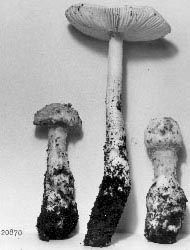
Amanita cinereoconia G. F. Atk. var. cinereoconia
[ image ] [ page ]
Cades Cove [TENN (HN & u.d.)] H-20870, H-35190
Grotto Falls trailhead [RET (u.d.)] RET 7-12-04-AF
-
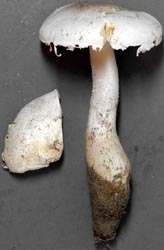
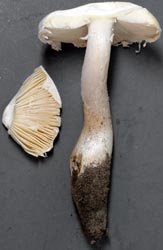
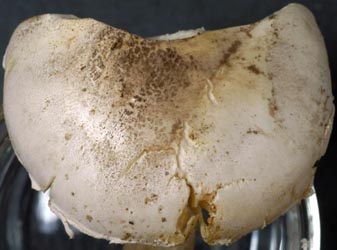
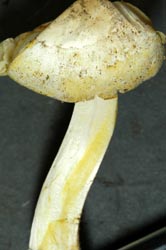
Amanita cinereoconia var. croceescens Bas
[ image ] [ page ]
RET has doubts about the taxonomic value of this taxon. From experience with 7-17-06-A, material determined under
the present name may simply be material of the type variety exhibiting the "yellowing
syndrome."
Abrams Crk. Tr. beyond camping area [RET & TENN] RET 7-17-06-A (=TFB 13315)
-
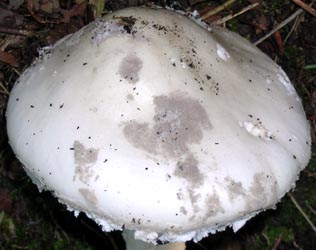
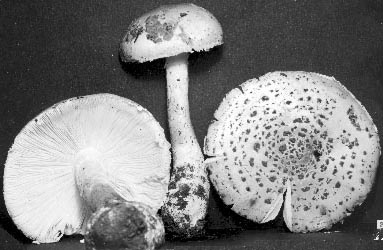
Amanita cinereopannosa Bas [ image ]
[page]
The irregular warts on the pileus sometimes give the impression of mudpies made by elven hands that left their fingerprints in their product.
There is often the odor of newly made biscuit dough in fresh material. The top of the bulb tends to crack in such a way as to suggest a wall
of concrete block. A small specimen might be taken for an extremely large specimen of A. onusta. Spores: [150/6/6]
(8.0-) 8.8 - 12.0 (-14.1) × (4.9-) 5.2 - 7.0 (-8.3) µm, (L = 9.5 - 10.9 µm; L’ = 10.2 µm; W = 5.6 - 6.1 µm; W’ = 6.0 µm;
Q = (1.30-) 1.50 - 2.0 (-2.40); Q = 1.63 - 1.82; Q’ = 1.72).
Cades Cove [L, TENN (BAS69)] !!PARATYPE from this site!! H-21822
Deep Crk. Campground [TENN (u.d.)] RET 7-19-06-A (=?? =TFB 13299)
Grotto Falls trailhead [RET (u.d.)] RET 7-12-04-AF
-
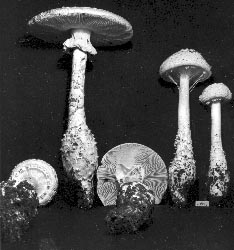
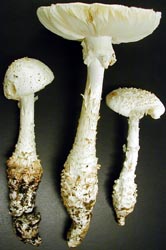
Amanita cokeri (E.- J. Gilbert & Kühner) E.- J. Gilbert [image]
[page]
Compare with A. subcokeri. Spores: [95/5/4] (9.2-) 10.8 - 13.2 (-15.0) × (5.5-) 6.5 - 8.7 (-9.5) µm,
(L = 11.4 - 12.7 µm; L’ = 11.9 µm; W = (6.9-) 7.8 - 8.1 µm; W’ = 7.8 µm; Q = (1.27-) 1.35 - 1.79 (-2.0);
Q = 1.44 - 1.56 (-1.74); Q’ = 1.53).
Cades Cove [TENN (BAS69, HPL, HN, u.d.)] H-8265, H-20868, H-20869, H-20875,
H-21832, H-25683
?Cades Cove, Anthony Crk. Tr. [RET (u.d.)] FU-0623
Cherokee Orchard, Rainbow Falls Tr. [RET (u.d.)] RET 7-12-04-A
-
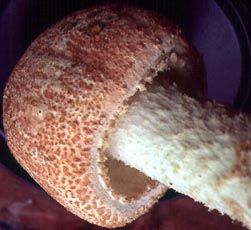
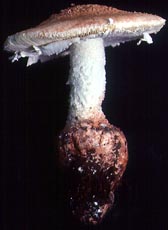
Amanita daucipes (Mont.) Lloyd [ image ]
[ page ]
Spores: [100/5/5] (8.0-) 9.1 - 11.5 (-13.8) × (5.3-) 5.5 - 7.2 (-9.9) µm, (L = 9.8 - 10.8 µm; L’ = 10.2 µm; W = 6.0 - 6.5 µm;
W’ = 6.2 µm; Q = (1.22-) 1.48 - 1.82 (-1.93); Q = 1.57 - 1.68; Q’ = 1.64).
Cades Cove, Hyatt Lane [TENN (u.d.)] DJL-TN-82
-
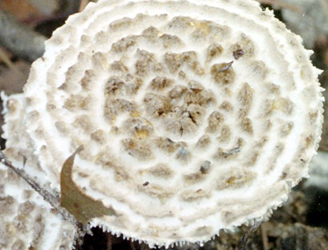
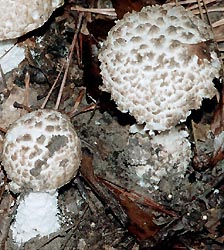
Amanita hesleri Bas [ image ]
[ page ]
Lacking a pileipellis, volva arising from the pileus context and comprising chains of elongate cells in addition to hyphae. Spores: [260/12/7]
(8.5-) 9.5 - 12.5 (-16.1) × (4.8-) 5.1 - 6.5 (-7.8) µm, (L = (10.0-) 10.4 - 11.1 µm; L’ = 10.7 µm; W = (5.4-) 5.5 - 6.1 µm;
W’ = 5.9 µm; Q = (1.50-) 1.60 - 2.18 (-2.70); Q = 1.71 - 1.95 (-2.08); Q’ = 1.84).
Cades Cove [L, TENN (BAS69)] !!PARATYPE from this site!! H-22694
-
Amanita inodora (Murrill) Bas
[page]
-
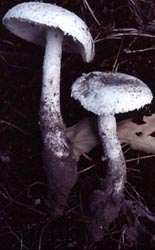
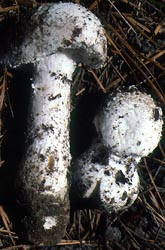
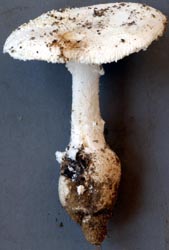
Amanita longipes Bas ex Tulloss & Dav. T. Jenkins
[image]
[page]
This species was originally described from pine-oak barrens of the coastal plain on Long Island, NY and in southern NJ. It's range extends through
the Appalachians to Alabama. Spores: [820/41/41] (7.2-) 9.8 - 14.0 (-21) × (3.9-) 4.6 - 6.3 (-9.8) µm, (L = (10.3-) 10.4 - 12.7 (-13.6) µm;
L’ = 11.8 µm; W = (4.5-) 4.8 - 5.9 (-6.3) µm; W’ = 5.4 µm; Q = (1.50-) 1.75 - 2.63 (-3.50); Q = (1.85-) 1.94 - 2.48 (-2.51);
Q’ = 2.20).
Deep Crk. Ranger Stn. [TENN (u.d.)] RET 7-19-06-C (=?? =TFB 13293)
-
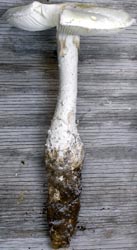
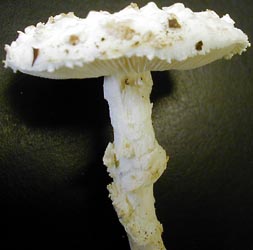
Amanita magniradix Tulloss nom. prov.* [ image ] [ page]
[=Amanita "sp. 9" Tullossl cryptonom. temp.]
Usually with an extremely long radicating basal bulb that is extremely difficult to excavate. The
specimen on the left, above, is an exception. The cap of this species bears a notable
sterile margin extending a few mm beyond the outer ends of the lamellae. Spores: [250/12/12] (6.5-) 8.4 - 11.7 (-14.7) × (4.3-) 4.5 - 6.3 (-7.8) µm,
(L = (8.7-) 9.1 - 11.0 µm; L’ = 10.1 µm; W = 4.9 - 6.1 (-6.2) µm; W’ = 5.4 µm; Q = (1.43-) 1.57 - 2.18 (-2.89);
Q = 1.69 - 1.97 (-2.17); Q’ = 1.86).
Cades Cove, Loop Rd. near outlet [RET (u.d.)] RET 9-27-06-J
Grotto Falls Tr. [RET (u.d.)] RET 7-12-04-Q
-
Amanita marginata Dav. T. Jenkins [ page ]
Cades Cove [DTJ (JE81)] !!TYPE LOCALITY!!
-
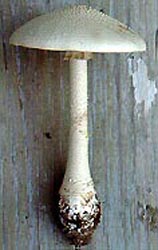
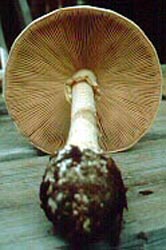
Amanita microlepis Bas [ image ]
[ page ]
The range of this species extends at least from southern New England to South Carolina. Spores: [55/3/3] (8.2-) 8.4 - 10.8 × (5.6-) 5.9 - 7.3 (-8.0) µm,
(L = 9.3 - 9.9 µm; L’ = 9.5 µm; W = 6.2 - 7.0 µm; W’ = 6.6 µm; Q = (1.22-) 1.27 - 1.60 (-1.86); Q = 1.36 - 1.51;
Q’ = 1.45.
-
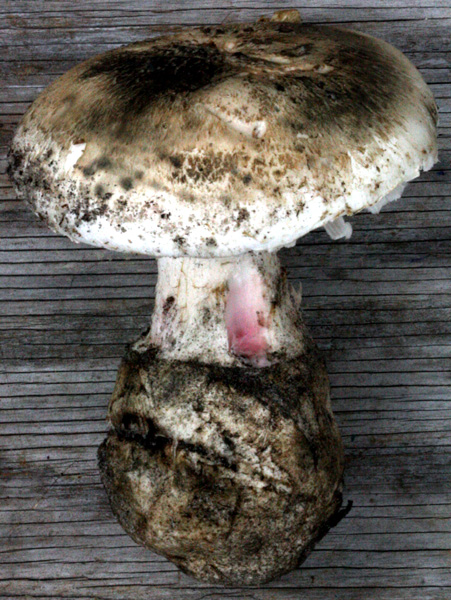 Amanita mutabilis Beardslee
[ image ] [page ]
Amanita mutabilis Beardslee
[ image ] [page ]
u.d.
Spores:[235/11/10] (8.7-) 10.0 - 14.6 (-18.9) × (5.0-) 6.0 - 8.0 (-12.6) µm, (L = 11.0 - 13.1 (-13.8) µm; L’ = 12.0 µm; W = 6.6 - 7.6 (-8.3) µm; W’ = 7.0 µm; Q = (1.30-) 1.50 - 1.90 (-2.13); Q = 1.60 - 1.78 (-1.89); Q’ = 1.71)
-
Amanita nitida sensu Coker [ page ]
Known from North Carolina.
-
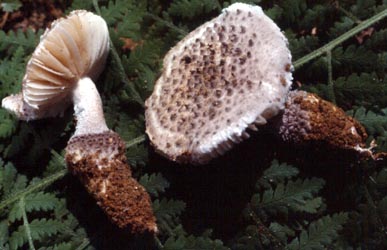
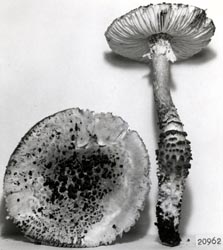
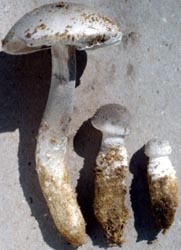
Amanita onusta (Howe) Sacc. [ image]
[ page ]
A very large specimen might be mistaken for a small specimen of A. cinereopannosa. Spores: [215/12/12]
(7.0-) 8.0 - 11.0 (-13.0) × (5.0-) 5.5 - 7.0 (-8.3) µm, (L = 8.3 - 10.5 (-11.0) µm; L’ = 9.4 µm; W = 5.7 - 6.5 (-7.1) µm;
W’ = 6.1 µm; Q = (1.14-) 1.28 - 1.85 (-2.21); Q = 1.35 - 1.65 (-1.84); Q’ = 1.52).
Baskin's Ridge trailhead [RET (u.d.)] RET 7-12-04-AD
?Cataloochee Valley [RET (u.d.)] FU-0161, FU-0548
Clingman's Dome (TENN (HN)] H-21549
Heintooga Road & Rough Fork Tr., Polls Gap [RET (u.d.)] FU-0647
Indian Gap [TENN (HN)] H-20962
Newfound Gap [TENN (HPL & HN)] H-9051
Turkey Pen Ridge Tr. trailhead @ Laurel Crk. Rd. [TENN (u.d.)] ?? (=TFB 13128)
-
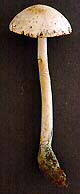
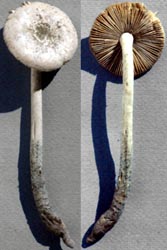
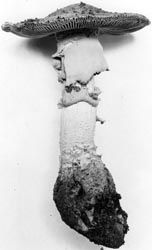
Amanita pelioma Bas [ image ]
[ page ]
The range of this species extends (at least) from the southern Catskill Mtns. in New York state to the Gulf Coast; it is known from North Carolina.
This is the only known species of Amanita north of the Mexican deserts that develops a blue-green tint or stain. In this case, it appears
to be the volva that has this odd pigmentation. The gills are cafe-au-lait color as in A. microlepis. Spores:
[125/5/3] (8.8-) 9.8 - 13.6 (-15.0) × (5.5-) 6.0 - 9.1 (-10.1) µm, (L = 10.6 - 12.1 µm; L’ = 11.5 µm; W = 6.5 - 8.1 µm;
W’ = 7.2 µm; Q = (1.21-) 1.1.38 - 1.85 (-2.22); Q = 1.49 - 1.76; Q’ = 1.61).
-
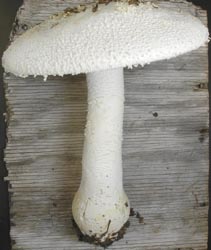
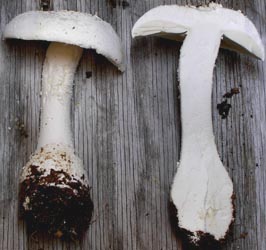
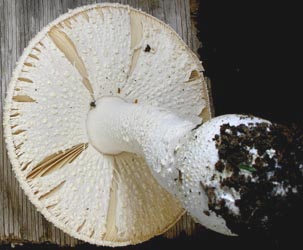
Amanita polypyramis (Berk. & Curt.) Sacc.
[ image ] [ page ]
Large white mushroom with a solid stipe. Extremely distinctive in the field and rather quickly recognized by a collector once it is
known to her/him. Pileus thick, covered with small pyramidal warts. Top half of bulb bearing many rings of small white warts.
Spores: [285/13/11] (7.0-) 9.1 - 13.0 (-17.5) × (5.2-) 5.9 - 7.7 (-9.5) µm, (L = (9.0-) 10.0 - 12.1 µm; L’ = 11.4 µm;
W = 6.5 - 7.2 (-7.4) µm; W’ = 6.8 µm; Q = (1.11-) 1.38 - 1.93 (-2.02); Q = (1.35-) 1.50 - 1.81; Q’ = 1.67).
Cades Cove, Loop Rd. [RET, TENN (u.d.)] RET 9-27-06-K (=TFB 13413)
-
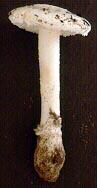
Amanita praelongispora (Murrill) Murrill [ image ]
[ page ]
The volva forms a membranous limb on the top of the stipe's basal bulb. Compare with A.
roanokensis. Spores: [85/3/3] (8.7-) 9.4 - 12.3 (-16.4) × (3.5-) 3.8 - 4.9 (-5.2) µm, (L = 10.7 - 11.7 µm; L’ = 11.2 µm;
W = 4.2 - 4.6 µm; W’ = 4.3 µm; Q = (1.87-) 2.06 - 2.93 (-3.15); Q = 2.49 - 2.80; Q’ = 2.57).
-
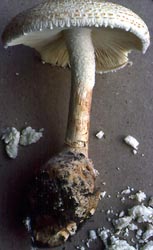
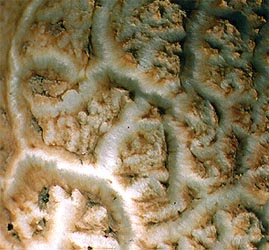
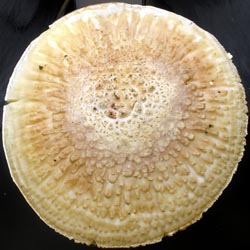
Amanita ravenelii (Berk. & Curt.) Sacc. [ image ]
[ page ]
Because of the strong vertical orientation of the elements of the universal veil, the sides of the warts on the pileus of this species have the appearance of
eroded hillsides (vertically striate). The shape of the bulb is very variable and can be very irregular in form. Compare to A.
rhopalopus. Spores: [285/13/11] (7.0-) 8.0 - 11.9 (14.0) × (4.6-) 5.2 - 7.7 (-8.5) µm, (L = (8.3-) 8.5 - 11.1 µm; L’ = 9.7;
W = 5.6 - 7.0 (-7.4) µm; W’ = 6.3 µm; Q = (1.23-) 1.33 - 1.81 (-2.50); Q = 1.46 - 1.64 (-1.81); Q’ = 1.54).
Cades Cove [L, MICH, TENN (BAS69)] H-22418
-
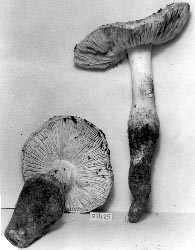
Amanita rhoadsii Murrill
[ image ] [page ]
u.d.
Spores:[85/3/3] (9.8-) 10.1 - 14.5 (-18.5) × (3.5-) 3.8 - 4.8 µm, (L = 11.7 - 13.9 µm; L' = 12.1 µm; W = 4.1 - 4.3 µm; W' = 4.3 µm; Q = (2.22-) 2.40 - 3.49 (-4.14); Q = 2.66 - 3.25; Q' = 2.82)
-
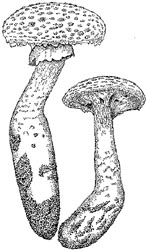
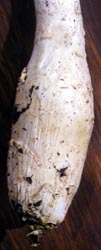
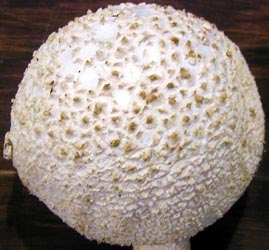
Amanita rhopalopus Bas f. rhopalopus [ image ]
[ page]
The universal veil is disorganized in comparison to that of A. ravenelii and, hence, in warts, the eroded appearance of
the sides is not seen in the present species. The stipe and bulb are often "dog-legged." Spores: [110/5/5] (7.3-) 8.0 - 10.9 (-12.5) ×
(4.8-) 5.4 - 6.8 (-8.1) µm, (L = 8.6 - 10.0 µm; L’ = 9.2 µm; W = 5.9 - 6.4 µm; W’ = 6.1 µm; Q = (1.19-) 1.32 - 1.745 (-1.88);
Q = 1.46 - 1.61; Q’ = 1.52).
Cades Cove [L, MICH, TENN (BAS69)] !!PARATYPE from this site!! H-12852, H-22132 p.p.
?Cades Cove, Anthony Crk. Tr. [RET (u.d.)] FU-0622
-
Amanita rhopalopus f. turbinata Bas
Differs from the type form in having a top-shaped basal bulb on the
stipe. The difference in spore shape between the two forms
mentioned by Bas has not held up when further collections were found and
their spores measured. The taxonomic value of f. turbinata is questionable.
-
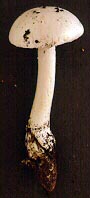
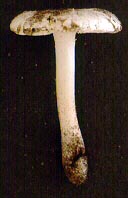
Amanita roanokensis Coker [ image ]
[ page ]
The volva forms a short, membranous limb on the bulb. Range from North Carolina to the Gulf Coast. The species is largely reported
(to date) from the coastal plain. Compare with A. praelongispora. Spores: [40/2/2] (12.0-) 12.8 - 17.1 (-19.5) ×
3.6 - 4.9 (-5.0) µm, (L = 14.4 - 14.7 µm; L’ = 14.6 µm; W = 4.1 - 4.4 µm; W’ = 4.2 µm; Q = (2.62-) 2.73 - 4.08 (-4.67);
Q = 3.32 - 3.70; Q’ = 3.51).
-
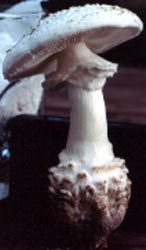
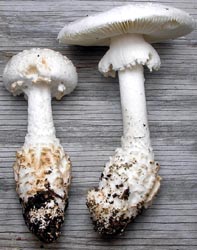
Amanita subcokeri Tulloss nom prov.* [ image ] [ page ]
[=Amanita "sp. 5" Tulloss]
Having large rooting bulb with recurved scales, occasionally having “doubled” partial veil (see photo, above
left), odorous (burnt sugar mixed with cedar chest), acquiring brick red spots, warts unusually liable to attack by Penicillium spp.,
spores proportionately too narrow for A. cokeri. Spores: [461/23/23] (8.0-) 10.2 - 14.0 (-19.0) × (5.2-) 5.9 - 7.5 (-10.9) µm,
(L = (10.7-) 10.8 - 13.6 (-13.8) µm; L’ = 12.1 µm; W = (6.0-) 6.1 - 7.0 µm; W’ = 6.6 µm; Q = (1.33-) 1.57 - 2.17 (-2.82);
Q = (1.59-) 1.64 - 2.02 (-2.11); Q’ = 1.85).
Finley Cane Tr., trailhead [RET (u.d.)] FU-0624
Greenbrier [RET (u.d.)] RET 9-25-06-A
Palmer Crk. Tr. [RET (u.d.)] FU-0261
-
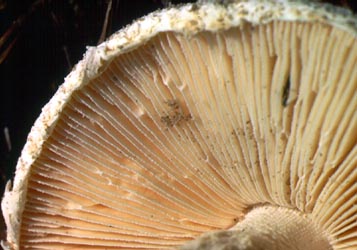
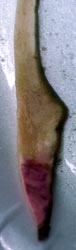
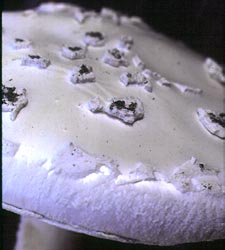
Amanita subsolitaria (Murrill) Murrill [ image ]
[ page ]
[=A. solitariiformis (Murrill) Murrill = A. crassifolia Bas nom. prov.]
Gills distinctively yellow-cream from early development. Universal veil on pileus from cake-like warts to pulverulence
(sometimes on a single specimen). Gills often forking. Occasionally exhibits yellowing
syndrome. Laccase+ in base of radicating bulb. Range from Cape Cod, Massachusetts to Florida and Gulf Coast. Spores: [596/27/27]
(7.3-) 9.1 - 14.0 (-21) × (3.5-) 4.2 - 5.2 (-6.5) µm, (L = (8.9-) 9.6 - 12.7 (-13.6) µm; L’ = 11.4 µm; W = (4.1-) 4.3 - 5.1 µm;
W’ = 4.6 µm; Q = (1.57-) 2.0 - 3.0 (-3.83); Q = (2.03-) 2.21 - 2.79 (-2.81); Q’ = 2.47).
-
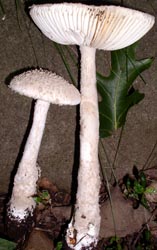
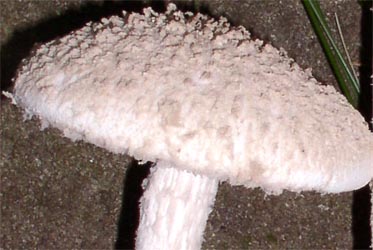
Amanita tephrea Bas nom. prov.* [ image ] [page]
Known from South Carolina to New Jersey and Long Island, New York. A taxon phenetically closely related to to
A. chlorinosma. White at first, then pale beige, and finally pale grayish. Rather small and
gracile in material found in recent years.
Formerly also known as "species S2" in RET's keys, notes,
correspondence, etc. Spores: [159/7/7] (7.5-) 8.6 - 12.3 (-17.1) × (5.2-)
5.6 - 8.0 (-9.6) µm, (L = 9.1 - 11.2 µm;
L’ = 10.6 µm; W = 6.0 - 7.3 µm;
W’ = 6.7 µm; Q = (1.16-) 1.34 - 1.93 (-2.56);
Q = 1.47 - 1.75; Q’ = 1.59).
Cades Cove [MICH, TENN (BAS69)] H-23016
Cades Cove, Picnic Area [RET (u.d.)] RET 9-27-06-E
Cherokee Orchard, Rainbow Falls Tr. [RET (u.d.)] RET 7-12-04-F
-
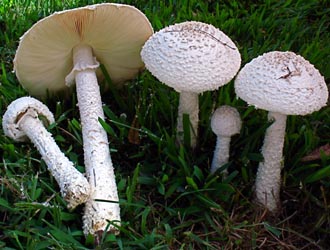 Amanita thiersii Bas nom. prov. [ image ] [page]
Spores: [70/4/4] (7.0-) 7.7 - 9.5 (-11.0) × (6.8-) 7.5 - 9.5
(-10.0) µm, (L = 8.1 - 8.7 µm; L’ =
8.4 µm; W = 7.8 - 8.2 µm; W’ = 8.0 µm;
Q = (1.0-) 1.01 - 1.10 (-1.17); Q = 1.04 -
1.07; Q’ = 1.05).
[top] [skip section] [top of previous section]
Amanita section Phalloideae
[
N. Amer. Phalloideae key ]
[4 known from park of 9
± probable (note: some cited names may be taxonomic synonyms)]
-
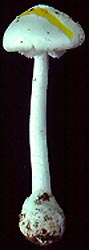
Amanita bisporigera G. F. Atk. [image]
[page]
KOH+. Tyrosinase-. Odorless at first, sickeningly sweet in age. Spores: [452/19/16] (5.2-) 7.2 - 9.9 (-11.0) × (4.8-) 6.5 - 8.6 (-10.0) µm,
(L = (7.8-) 7.9 - 9.2 (-9.6) µm; L’ = 8.4 µm; W = (7.0-) 7.1 - 8.1 (-8.2) µm; W’ = 7.5 µm; Q = (1.0-) 1.02 - 1.25 (-1.70);
Q = (1.05-) 1.06 - 1.18 (-1.20); Q’ = 1.11).
?? [TENN (HPL)]
Cades Cove, Gum Swamp [TENN (u.d.)] ?? (=TFB 13252)
Cataloochee Valley [RET (u.d.)] FU-0259, FU-0331, FU-0337
Cherokee Orchard, Rainbow Falls Tr. [RET (u.d.)] RET 7-12-04-E
Greenbrier, Old Settler's Tr. [TENN (u.d.)] ?? (=TFB 13263)
Little Cataloochee Tr. [RET (u.d.)] FU-0274
-
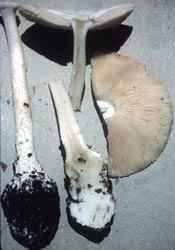
Amanita elliptosperma G. F. Atk. [ image ]
[ page ]
KOH-. Tyrosinase+. Having ample, superior, membranous partial veil. Odor was not mentioned in unfortunately brief protologue; however,
collections consistent with the type have odors described as "dirty socks," "old ham," or "something
like phalloides, but with addition of "chlorine." The gills can be pinkish in mass in
some lights. Very similar to A. sp. S4. Originally described from Chapel Hill, North
Carolina, with range extending north to at least West Virginia and probably further, possibly occurring as far south as the Gulf
Coast and eastern Texas. Spores from holotype: [110/4/4] (8.0-) 8.7 - 11.2 (-11.5) × (5.8-) 5.9 - 7.5 (-7.8) µm, (L = 9.6 - 9.9 µm;
L' = 9.8 µm; W = 6.5 - 6.9 µm; W' = 6.8 µm; Q = (1.25-) 1.29 - 1.60 (-1.71); Q = 1.40 - 1.50; Q' = 1.45).
-
Amanita gwyniana Coker [ page ]
Odor of "chloride of lime." Originally described from North Carolina. Spores from holotype: (8.4-) 8.9 - 11.8 (-12.4) × 6.0 - 8.0 (-8.7) µm, with Q = 1.46 - 1.54.
?Cades Cove, Loop Rd. ("stop 1") [TENN (u.d.); RET (u.d.)] (=TFB 13423)
-
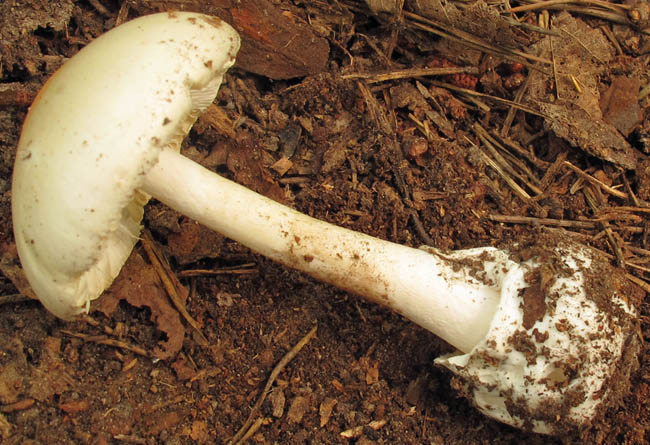 Amanita helmettensis Tulloss & Kudzma nom. prov.
[ image ] [page ]
Amanita helmettensis Tulloss & Kudzma nom. prov.
[ image ] [page ]
u.d.
Spores:[40/1/1] (8.0-) 8.5 - 11.0 (-12.5) × (7.5-) 7.6 - 10.0 (-12.2) μm, (L = 9.5 μm; W = 8.7 μm; Q = (1.02-) 1.05 - 1.16 (-1.27); Q = 1.09)
-
Amanita hygroscopica Coker
[ page ]
Originally described from North Carolina, (additionally known several times from outside the park in the same state). Lamellae described as pink and becoming more intensely pigmented with age. Could this taxon be based
on some water-soaked, small material of A. elliptosperma? Spores: ??
[TENN (HPL)]
-
Amanita longitibiale Tulloss, Perez-Silva & T. Herrera [ image ]
[ page ]
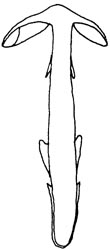
Paratype from NC outside of park. Stipe's bulb is long and narrow; volva is saccate and attached only near base of elongated bulb. Spores: [200/9/6] (9.4-) 10.5 - 13.3 (-14.8) × (4.2-) 5.0 - 6.3 (-7.2) µm, (L = 11.4 - 12.3 (-12.6) µm; L’ = 11.8 µm; W = (5.4-) 5.6 - 5.9 µm; W’ = 5.7 µm; Q = (1.56-) 1.79 - 2.31 (-3.05); Q = 1.99 - 2.19 (-2.28); Q’ = 2.08).
-
Amanita magnivelaris Peck [ image ] [ page ]
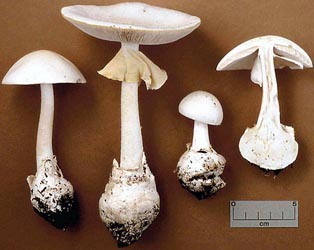
Usually KOH-. Some specimens exihibit a yellowing reaction to cutting or bruising (yellowing
syndrome?) and these may be KOH+ (Y. Lamoureux, pers. corresp.). An off-white species with a thick and felted, rather than thin and
membranous, cream-colored partial veil. Known mostly from New York, Wisconsin, and southeastern Canada. Spores [160/8/5]
(7.2-) 8.2 - 10.8 (-12.5) × (5.2-) 5.8 - 7.8 (-9.2) µm, (L = 8.7 - 9.9 µm; L' = 9.5 µm; W = 6.0 - 7.1 µm; W' = 6.6 µm; Q = (1.15-) 1.27 - 1.62 (-1.72);
Q = 1.38 - 1.49; Q' = 1.43).
-
Amanita mediinox Tulloss nom. prov.* [ image ] [ page ]
[=Amanita "sp. S9" Tulloss nom. prov.)
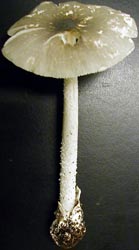
Collectors have reported the buttons of this species are black or midnight blue. Tulloss has never seen a button. The species belongs in a small
group of the Phalloideae with pigmented caps that do not have the pigments organized in the pointilliste manner of A. phalloides.
Spores: [85/4/4] (8.0-) 8.5 - 13.5 (-15.5) × (5.0-) 5.2 - 6.5 (-8.5) µm, (L = 9.1 - 12.1 µm; L' = 10.6 µm; W = 5.6 - 6.5 µm;
Q = (1.40-) 1.52 - 2.09 (-2.42); Q = 1.54 - 1.89; Q' = 1.78).
Cherokee Orchard, Rainbow Falls Tr. [RET (u.d.)] RET 7-12-04-AA
-
Amanita virosa sensu Coker
Known from North Carolina.
-
95.
 Amanita virosiformis
(Murrill) Murrill
[ image ]
[ page ]
Amanita virosiformis
(Murrill) Murrill
[ image ]
[ page ]
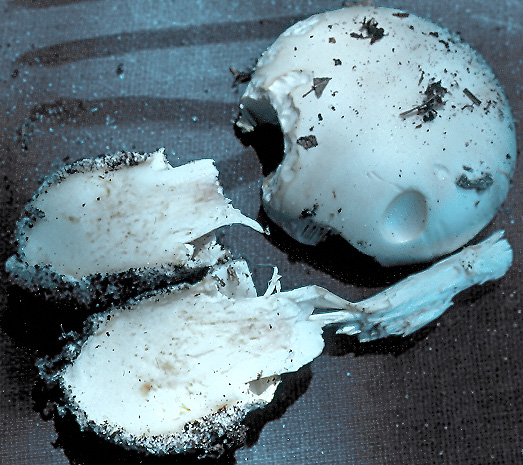
Spores: [166/7/4] (9.5-) 10.2 - 13.8 (-16.0) × (3.8-) 4.2 -
5.8 (-6.5) μm, (L = 11.2 - 12.3 μm;
L' = 11.9 μm; W = 4.4 - 5.5 μm;
W' = 4.8 μm; Q = (1.74-) 2.08 - 3.06
(-3.62); Q = 2.25 - 2.76; Q' = 2.50).
-
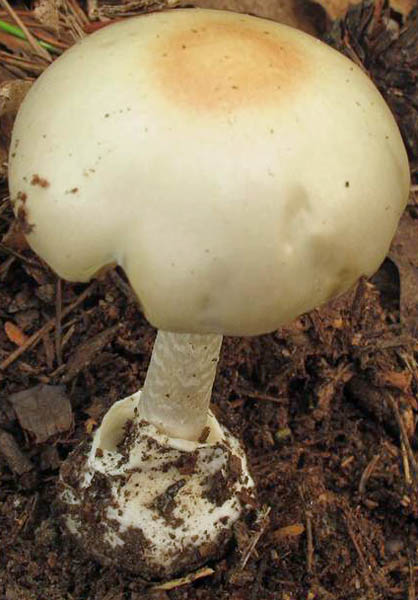
Amanita sp-bisporigera05
Tulloss cryptonom. temp.
[ image ]
[ page ]
KOH+. Spores: [40/1/1] (8.0-) 8.5 - 11.0 (-12.5) × (7.5-) 7.6 -
10.0 (-12.2) μm, (L = 9.5 μm; W = 8.7
μm; Q = (1.02-) 1.05 - 1.16 (-1.27); Q =
1.09).
-
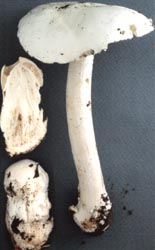
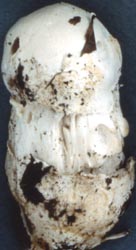
Amanita sp-S04 Tulloss cryptonom. temp. [ image ] [ page ]
KOH-. Tyrosinase+. Odor of chlorine or "chloride of lime." White species with thin and membranous partial veil. Gills sometimes pinkish (see sectioned button on left above). Known from West Virginia to Texas. Very similar to A.
elliptosperma. Spores: [165/7/5] (7.3-) 8.4 - 11.2 (-13.5) × (4.9-) 5.5 - 6.8 (-8.5) µm, (L = 9.0 - 9.7 (-10.3) µm; L' = 9.6 µm;
W = 5.9 - 6.3 µm; W' = 6.0 µm; Q = (1.30-) 1.41 - 1.83 (-2.0); Q = 1.50 - 1.60 (-1.69); Q' = 1.58).
[top] [skip section]
[top of previous section]
Amanita section Validae
[10 (11) known from park of 23+ probable]
-
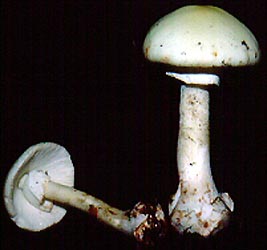 Amanita aestivalis Singer [ image ]
[ page ]
Amanita aestivalis Singer [ image ]
[ page ]
Truly white except for disc. Very much slower to stain than A. brunnescens.
Spores: [200/9/6] (5.8-) 7.0 - 9.5 (-10.9) × (5.0-) 6.8 - 8.8 (-10.5) µm, (L = (7.6-) 7.9 - 8.6 µm; L’ = 8.4 µm; W = (7.2-) 7.5 - 8.0 µm;
W’ = 7.8 µm; Q = (1.0-) 1.02 - 1.14 (-1.20); Q = 106 - 1.08 (-1.09); Q’ = 1.07).
Cataloochee Valley [RET (u.d.)] FU-0197
Cherokee Orchard [RET (u.d.)] RET 7-12-04-B
-
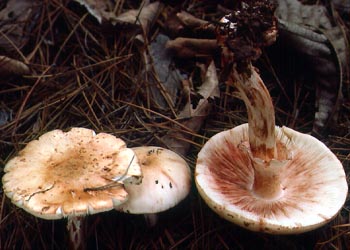
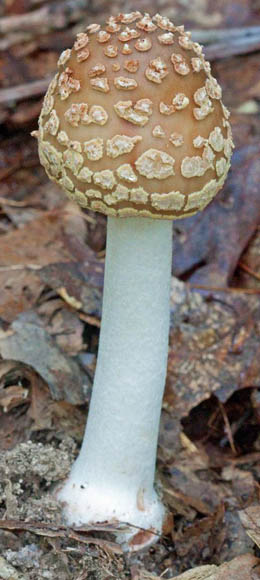
Amanita
aureosubucula Tulloss & K. W. Hughes
nom. prov.*
[ image ]
[ page ]
This is a common "rubescens" of eastern Canada and the eastern US.
It is distinct from the European
A. rubescens. Spores:
[95/3/3] (7.0-) 7.5 - 10.0 (-11.2) × (4.9-) 5.5
- 7.0 (-8.3) μm, (L = 8.4- 9.2 μm; L' =
8.7 μm; W = 5.9 - 6.3 μm; W' = 6.1 μm;
Q = (1.19-) 1.27 - 1.65 (-1.69); Q = 1.32 -
1.52; Q' = 1.43).
Grotto Falls Tr. [RET (u.d.)] RET 7-12-04-U
-
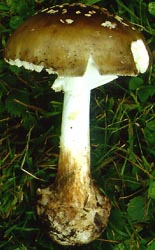
Amanita brunnescens G. F.
Atk. [ image ]
[ page ]
[= Amanita brunnescens var. pallida L. Krieg.]
Spores: [35/2/2] (7.0-) 7.5 - 9.2 (-9.5) × (6.5-) 7.0 - 8.5 (-9.2) µm, (L = 8.2 - 8.7 µm; L’ = µm; W = 7.6 - 8.0 µm; W’ = µm;
Q = (1.0-) 1.03 - 1.15 (-1.18); Q = 1.08; Q’ = 1.08).
[TENN (HPL)]
Cataloochee Valley [RET (u.d.)] FU-0239
Cataloochee Valley [RET (u.d.)] FU-0554
Cherokee Orchard [RET (u.d.)] RET 7-12-04-AB
?Ocontaluftee River, approx. 1 mile N of Smokemont, E of Hwy. 441 btwn. rd. & river just N of turnout [RET (u.d.)] LLN-9
-
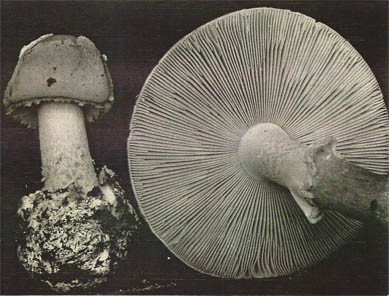 Amanita brunnescens var. straminea
[ image ] [page ]
Amanita brunnescens var. straminea
[ image ] [page ]
u.d.
Spores:[40/1/1] (7.5–) 7.8 – 8.5 (–9.2) × (6.8–) 7.0 – 8.2 (–9.0) µm, (L = 8.2 µm; W = 7.6; Q = (1.03–) 1.04 – 1.14 (–1.15); Q = 1.07)
-
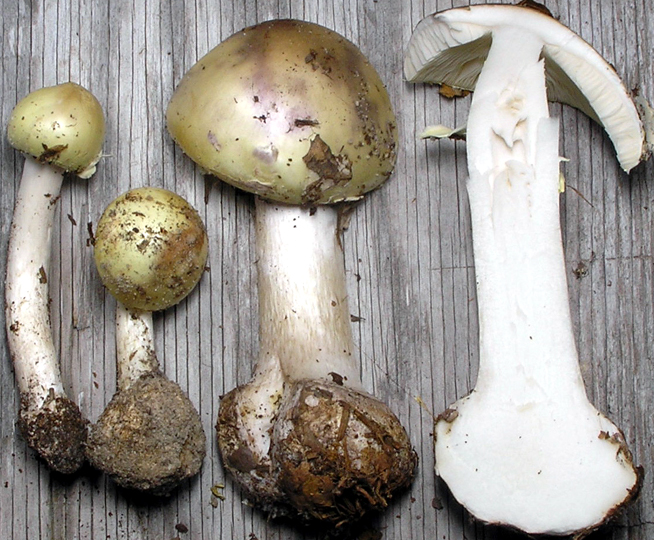
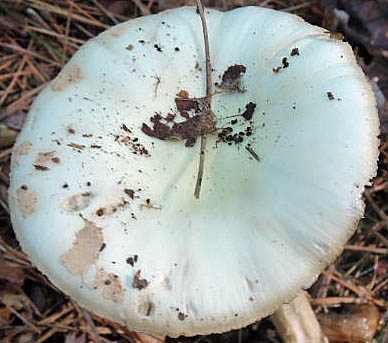
Amanita
cornelihybrida K. W. Hughes et al. [ image ]
[ page ]
This species is presently identifiable by genetic sequencing. If it is
very similar to another species that is undescribed that has very similar
spores. It can be segregated from the true A. lavendula by spore
size and shape. Spores:
[TENN (HPL)]
Cataloochee Valley [RET (u.d.)] FU-0255
-
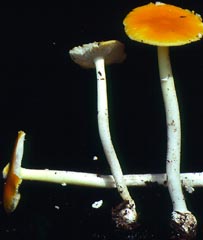
Amanita elongata
Peck [ image ]
[ page ]
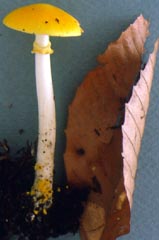
Apparently close to A. flavoconia, from which it is distinguished by pigmentation and spore shape (having narrower spores). The stipe of the present entity is dominantly (if not entirely) white. The cap is usually dominantly or entirely yellow (with some
exceptions that suggest the possibility of intergrading with A. flavoconia. The range of A. elongata extends from the Island of Newfoundland, Canada in the north to the GSMNP, southwestern South Carolina, and, possibly, further south. If A. elongata and A. flavoconia are to be placed at the rank of variety within a common species, the name having priority for the species is A. flavoconia. Spores: [133/7/7] (6.8-) 7.5 - 10.5 (-12.5) × (4.0-) 5.0 - 6.9 (-8.7) µm, (L = 7.9 - 9.6 µm; L’ = 8.7 µm; W = 5.3 - 6.4 µm; W’ = 5.8 µm; Q = (1.21-) 1.33 - 1.70 (-1.81); Q = 1.45 - 1.58; Q’ = 1.51).
Cades Cove, Loop Rd. (stop 1) [RET (u.d.)] RET 9-17-06-N
-
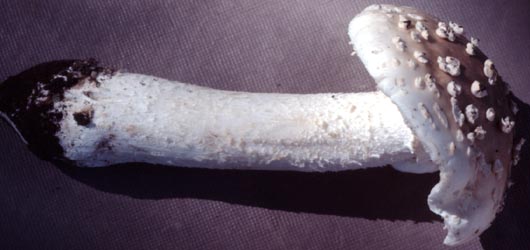
Amanita excelsa sensu
Coker (sp. 19 of RET)
[ image ]
[ page ]
[probably = Amanita "sp-19" of RET]
This taxon is descrbed with a photograph in (Coker 1917). Having uneven pileus margin, detersile warts, brown disk, robust stipe, large and fragile partial veil. Known range extends from New Jersey to North Carolina. Spores: [40/2/2] (7.0-) 7.3 - 9.8 (-11.5) × (4.5-) 4.9 - 6.2 (-6.5) µm, (L = 7.8 - 8.8 µm; L’ = 8.3 µm; W = 5.0 - 5.7 µm; W’ = 5.4 µm; Q = (1.31-) 1.40 - 1.69 (-1.92); Q = 1.54 - 1.56; Q’ = 1.55).
-
Amanita excelsa sensu Dav. T. Jenkins
Possibly A. submaculata (see below).
[TENN (HPL)]
-
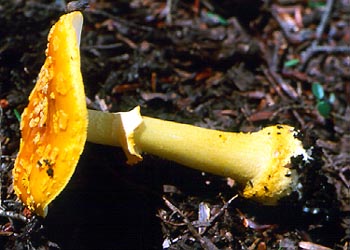
Amanita flavoconia G. F. Atk. var. flavoconia [image]
[page]
Spores: [139/8/8] (6.5-) 6.8 - 9.0 (-10.6) × (4.8-) 5.0 - 7.0 (-8.9) µm, (L = 7.2 - 8.2 (-8.6) µm; L’ = 7.9 µm; W = (5.3-) 5.5 - 6.9 µm; W’ = 6.0 µm; Q = (1.08-) 1.15 - 1.50 (-1.64); Q = 1.21 - 1.43 (-1.49); Q’ = 1.33).
Alum Cave trailhead [RET (u.d.) RET 7-13-04-B, LN2040713-05
?Cades Cove [TENN (HPL)] H-29202, H-30179
Cades Cove, Loop Rd. (stop 1) [RET (u.d.)] RET 9-27-06-M
Cataloochee Valley [RET (u.d.)] FU-0027
Cherokee Orchard, Rainbow Falls Tr. [RET (u.d.)] RET 7-12-04-T
Fork Ridge trailhead [RET (u.d.)] LN2040713-02
Heintooga Rd., picnic area [RET (u.d.)] FU-0360, FU-0653
Palmer Crk. Tr. [RET (u.d.)] FU-0277
-
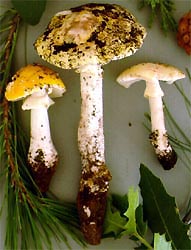
Amanita flavorubens (Berk. & Mont.) Sacc. [image]
[page]
[= Amanita flavorubescens G. F. Atk.]
This species is one of the few taxa known to extend down the east coast of N. America and into central Mexico and also to appear in the limited extension
of the western Madrean ecosystem in SE Arizona. Spores: [180/9/8] (7.4-) 7.8 - 11.0 (-12.6) × (4.9-) 5.4 - 7.0 (-8.4) µm, (L = 8.3 - 9.7 (-10.7) µm; L’ = 9.2 µm; W = (5.5-) 5.7 - 6.6 µm; W’ = 6.1 µm; Q = (1.17-) 1.28 - 1.76 (-1.96); Q = (1.34-) 1.37 - 1.67; Q’ = 1.52).
Cades Cove, Loop Rd. [TENN (u.d.)] ?? (=TFB 13414)
in park ca. Gatlinburg [TENN (HPL & HN); RET (u.d.)] H-64495
-
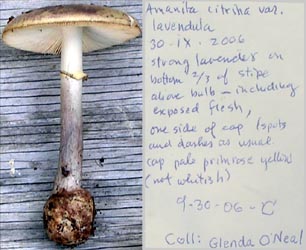
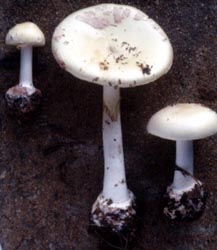
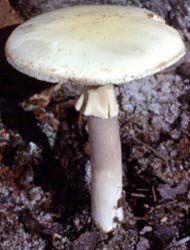
Amanita lavendula (Coker) Tulloss, K. W. Hughes,
Rodrig. Cayc., & Kudzma
[ image ] [ page ]
The
lavender coloring of volva, cap, and stipe, and lavender staining of
context may be dependent on environmental factors such as windchill [or
temperature] near or below freezing on a recent night.
Spores: [55/3/3] (6.3-) 6.4 - 8.0 (-8.8) × (5.2-) 5.5 - 7.1 (-7.8) µm,
(L = 7.0 - 7.2 µm; L’ = 7.1 µm; W = 6.0 - 6.4 µm;
W’ = 6.2 µm;
Q = (1.03-) 1.05 - 1.26 (-1.30); Q = 1.11 - 1.18;
Q’ = 1.15).
[TENN (HPL)]
Cades Cove, Forge Crk. Rd., [RET (u.d.)] RET 9-27-06-I
Cades Cove, Picnic Area [RET (u.d.)] RET 9-17-06-H
Rabbit Crk. Tr. [TENN (u.d.)] ??
(=TFB 12917)
-
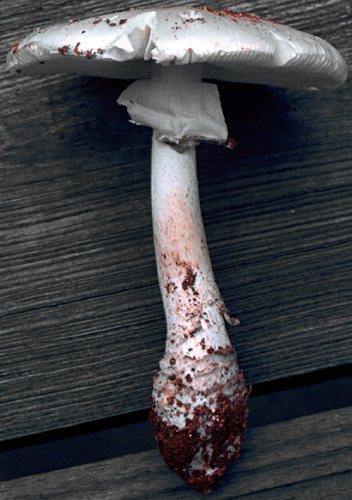
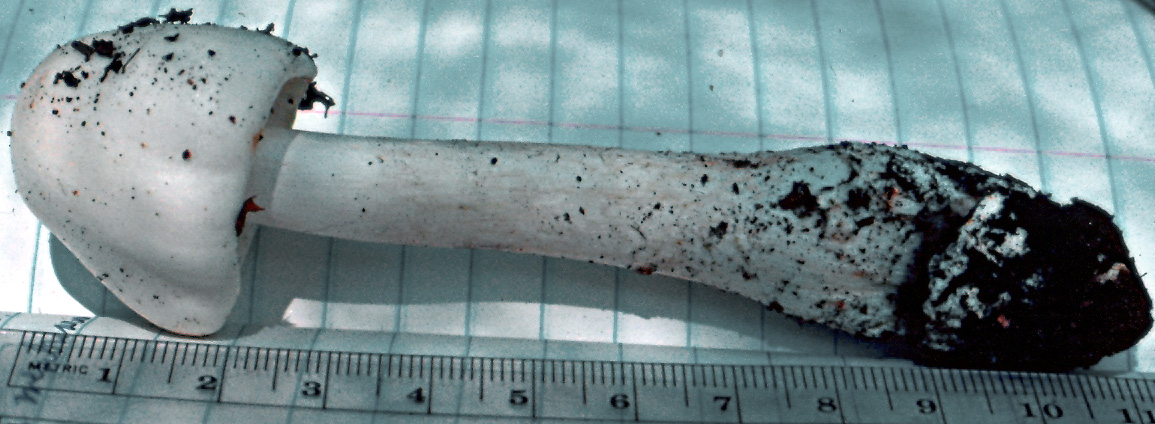
Amanita maryaliceae Tulloss nom. prov. [ image ] [ page]
Formerly known as "Amanita sp. N5." Pure white and appearing translucent when fresh. The species does not stain red; the red in the left image is from red clay in which the species was found in South Carolina. Its range is presenty thought to extend from Massachusetts to east Texas. Spores: [80/4/4] (6.3-) 7.0 - 8.7 (-9.4) × 4.9 - 6.3 (-6.6) µm, (L = 7.3 - 8.0 µm; L’ = 7.8 µm; W = 5.3 - 5.7 µm; W’ = 5.5 µm; Q = (1.19-) 1.25 - 1.62 (-1.71); Q = 1.35 - 1.50; Q’ = 1.42).
-
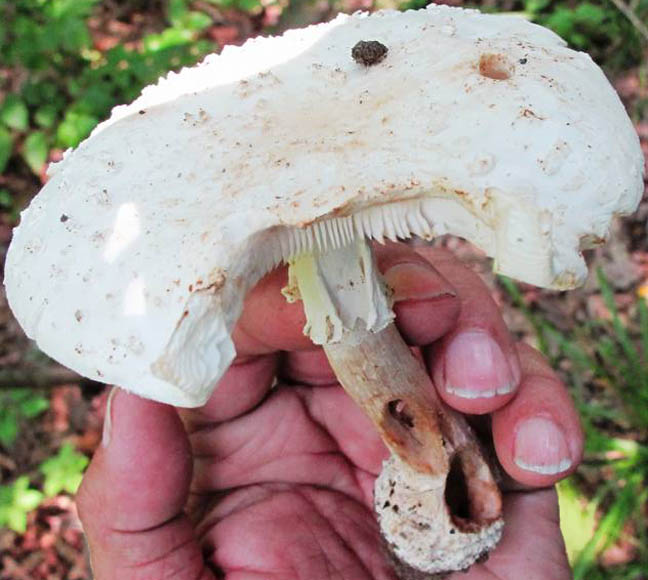 Amanita ostendemihi
[ image ] [page ]
Amanita ostendemihi
[ image ] [page ]
u.d.
Spores:[214/10/8] (5.9-) 6.8 - 9.0 (-10.4) × (4.1-)
4.9 - 6.2 (-7.2) μm, (L = 7.3 - 8.2 μm;
L' = 7.9 μm;
W = 5.2 - 5.5 (-6.0) μm; W' = 5.4 μm;
Q = (1.12-) 1.25 - 1.64 (-1.82);
Q = 1.35 - 1.51; Q' = 1.46)
-
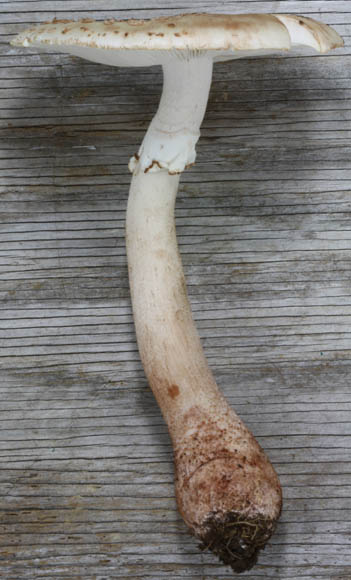
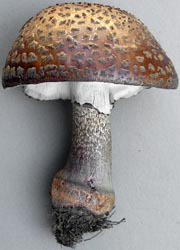
Amanita rubescens var.
alba Coker
[ image ]
[ page ]
Originally described from North Carolina. Very often, the cap is
pure white at first. Known range extends from NE USA at least
to Mexico. Some specimens (see photograph)
are liable to the blackening volva syndrome.
Spores: [140/7/6] (6.5-) 7.0 - 9.5 (-10.2) × (4.5-)
5.0 - 7.0 (-8.5) µm, (L = 7.6 - 9.0 µm;
L’ = 8.2 µm; W = 5.5 - 6.7 µm;
W’ = 5.9 µm; Q = (1.12-) 1.24 - 1.60 (-1.69);
Q = 1.34 - 1.49; Q’ = 1.40).
Alum Cave trailhead [RET (u.d.)] RET 7-13-04-J
-
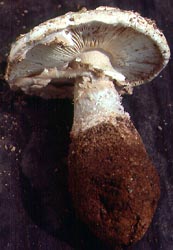
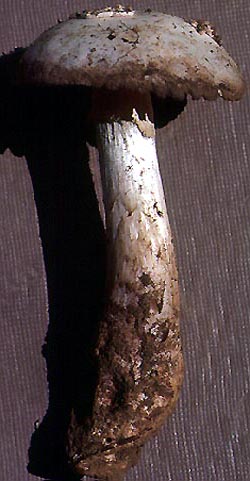
Amanita salmonescens Tulloss [ image ]
[ page ]
The range of this taxon as known at present extends from eastern Illinois to Connecticut, then southward to the Appalachian
foothills in western S. Carolina. Stipe bruising salmon then becoming sordid; spores: [144/6/5] (5.9-) 7.0 - 9.2 (-10.5) ×
(4.2-) 4.5 - 6.0 (-6.5) µm, (L = (7.7-) 7.8 - 8.4 µm; L’ = 8.1 µm; W = (4.9-) 5.2 - 5.6 µm; W’ = 5.3 µm;
Q = (1.18-) 1.35 - 1.75 (-1.88); Q = 1.45 - 1.57 (-1.62); Q’ = 1.54).
-
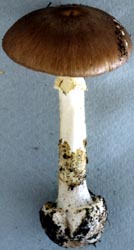
Amanita solaniolens (cf.) H. L. Stewart & Grund [ image ]
[ page ]
[ =Amanita sp-CR15 Tulloss cryptonom. temp.]
[=Amanita sp-N20 Tulloss cryptonom. temp.]
[=Amanita sp-O02 Tulloss cryptonom. temp.]
This species was originally described from Nova Scotia. Spores: [70/3/3] 7.0 - 8.8 (-10.5) × (5.5-) 6.5 - 8.0 (-9.5) µm,
(L = 7.9 - 8.2 µm; L’ = 8.0 µm; W = 7.1 - 7.4 µm; W’ = 7.2 µm; Q = (1.0-) 1.03 - 1.27 (-1.35);
Q = 1.06 - 1.16; Q’ = 1.11).
Alum Cave trailhead [RET (u.d.)] RET 7-13-04-J
Cataloochee Valley [RET (u.d.)] FU-0237, FU-0240, FU-0335
Cherokee Orchard, Rainbow Falls Tr. [RET (u.d.)] RET 7-12-04-K
-
Amanita spissa sensu Coker
[TENN (HPL)]
-
Amanita spissa var. alba Coker non Rick etc.
-
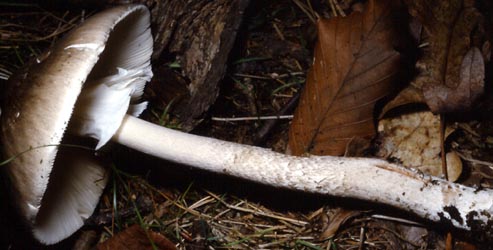
Amanita
submaculata Peck
[ image ]
[ page ]
This species has slipped out of the literature for decades and is only
just being recognized again. It can be recognized by its
gray-brown
cap, its grayish and friable volva, its large white partial veil
(like a broad, hooped skirt), and its odor (frequently of fruit or
anise or both). Its currently known range is from the northern
tier states of the eastern USA to the Carolinas, but its range
probably extends to both the north and south. Spores:
[406/19/16] (6.3-) 7.0 - 9.8 (-13.3) × (4.5-) 4.9 - 6.6 (-8.4) µm,
(L = (7.2-) 7.8 - 8.8 (-8.9) µm; L’ = 8.4 µm;
W = (5.2-) 5.5 - 6.2 µm; W’ = 5.7 µm; Q = (1.18-)
1.25 - 1.67 (-2.02); Q = (1.32-) 1.36 - 1.56 (-1.64);
Q’ = 1.47).
?Deep Crk. picnic area, ca. Bryson City [RET (u.d.)] FU-0636
?Deep Crk. Ranger Stn. [TENN (u.d.)] RET 7-19-06-D (=??=TFB 13296)
?Heintooga Rd., picnic area [RET (u.d.)] FU-0652
-
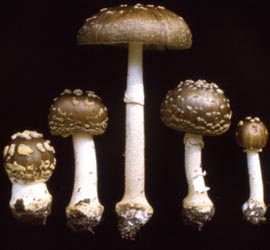
Amanita sp-10 Tulloss cryptonom. temp. [ image ]
[ page ]
Brown pileus; differing from sp-36 due to apparent innate fibrils in pileus, paler yellow volva, & a more olivaceous brown pileus; differing from European franchetii at least in lack of yellow exposed context when the immature pileipellis is scraped away; habit suggestive of flavoconia; liable to attack by Hypomyces hyalinus. Spores: [120/6/5] (6.6-) 7.3 - 9.5 (-12.5) × (4.7-) 5.3 - 6.3 (-7.8) µm, (L = 7.8 - 9.2 µm; L’ = 8.4 µm; W = 5.5 - 6.0 µm; W’ = 5.8 µm; Q = (1.18-) 1.30 - 1.62 (-1.73); Q = 1.37 - 1.55; Q’ = 1.46).
Possible from outside of park ca. Gatlinburg - H-25630.
-
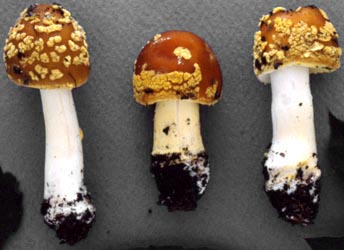
Amanita sp-36
Tulloss cryptonom. temp.*
[ image ]
[ page ]
[ = A. franchetii sensu Dav. T. Jenkins.]
This is not the European taxon Amanita franchetii. If the pileipellis is scraped once the cap has begun to emerge, the
color seen is always yellow. Spores: [100/5/3] (5.9-) 6.5 - 8.4 (-9.8) × (4.0-) 4.3 - 5.2 (-6.3) μm, (L = 7.2 - 7.6 μm; L' = 7.4 μm; W = 4.7 - 5.0 μm; W' = 4.8 μm; Q = (1.27-) 1.35 - 1.71 (-1.87); Q = 1.49 - 1.58; Q' = 1.54).
Cataloochee Valley [RET (u.d.)] FU-0237
-
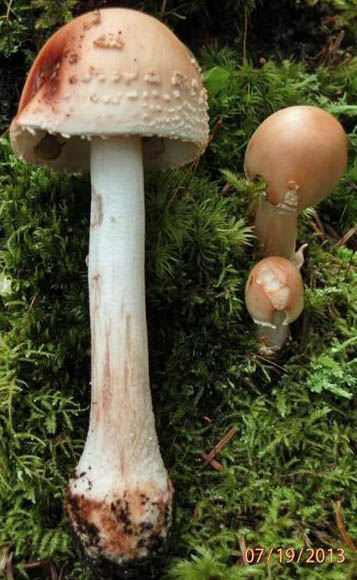
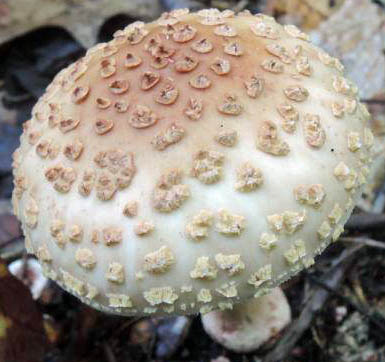
Amanita sp-amerirubescens02
Tulloss cryptonom. temp.
[ image ]
[ page ]
This is a common "rubescens" of eastern Canada and the eastern US.
It is distinct from the European
A. rubescens. Spores:
[170/7/7] (7.1-) 7.7 - 10.2 (-11.5) × (5.0-)
5.5 - 7.1 (-8.0) μm, (L = 8.0 - 9.3 μm;
L' = 8.7 μm; W = 5.7 - 6.8 μm;
W = 6.2 μm; Q = (1.13-) 1.22 - 1.61 (-1.81);
Q = 1.27 - 1.54; Q' = 1.41).
-
Amanita sp. M10 Tulloss cryptonom. temp.
?Cataloochee Valley [RET (u.d.)] FU-0340
-
Amanita sp-MD01 Tulloss cryptonom. temp. [ page ]
A red-capped "flavoconia." Spores: [60/3/2] (5.0-) 5.5 - 9.0 (-10.5) × (3.8-) 4.5 - 6.5 (-8.2) µm, (L = 6.6 - 7.8 µm; L’ = 7.3 µm; W = 5.3 - 5.8 µm; W’ = 5.6 µm; Q = (1.12-) 1.16 - 1.49 (-1.88); Q = 1.24 - 1.36; Q’ = 1.32).
Possible from Knox Co., TN: H-40041
[top] [skip section] [top of previous section]
Limacella
[1 known from park of 2
+ probable]
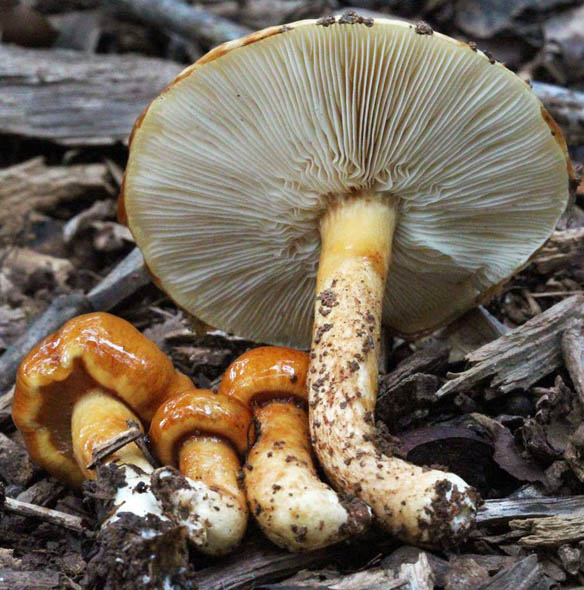
-
Limacella glischra (Morgan) Murrill.
[ image ]
[ page ]
Spores: [20/1/1] (3.6–) 3.9 – 4.6 (–5.3) × 3.5 – 4.4
(–5.0) µm, (L = 4.3 µm; L’ = 4.3 µm;
W = 3.9 µm; W’ = 3.9 µm; Q = 1.03 –
1.15 (–1.17); Q = 1.10; Q’ = 1.10).
-
Limacella kauffmanii H. V. Sm. [ page ]
locality not cited [MICH?, TENN (HVS45)]
[top]
[top of previous section]
LITERATURE CITED
[BAS69] Bas, C.
1969. Morphology and subdivision of
Amanita and a monograph of its section
Lepidella.
Persoonia 5: p 285-579.
[JE77] Jenkins, D. T.
1977.
A Taxonomic and Nomenclatural Study of the Genus
Amanita Section
Amanita for North America.
Biblioth. Micol. 57: 1-126.
[JE81] Jenkins, D. T.
1981. A new species of
Amanita.
Mycotaxon 13: 112-114.
[HVS45] Smith, H. V.
1945 ["1944"]. The genus
Limacella in North America.
Pap. Michigan Acad. Sci. 30: 125-147, pl. I.
[ Introduction ]
[ Interpreting this checklist ]
[ Amanita section Amanita ]
[ Amanita section Caesareae ]
[ Amanita section Vaginatae ]
[ Amanita section Amidella ]
[ Amanita section Lepidella ]
[ Amanita section Phalloideae ]
[ Amanita section Validae ]
[ Limacella ]
[ Literature cited ]
Page last altered on 30 April 2020
Created with the assistance of Lindsay Possiel in 2004, 2005, and
2006.
Photographs ("Ed Lickey gets the whole thing")
copyright 2006 by D. J. Lodge.
Maintained by R. E. Tulloss